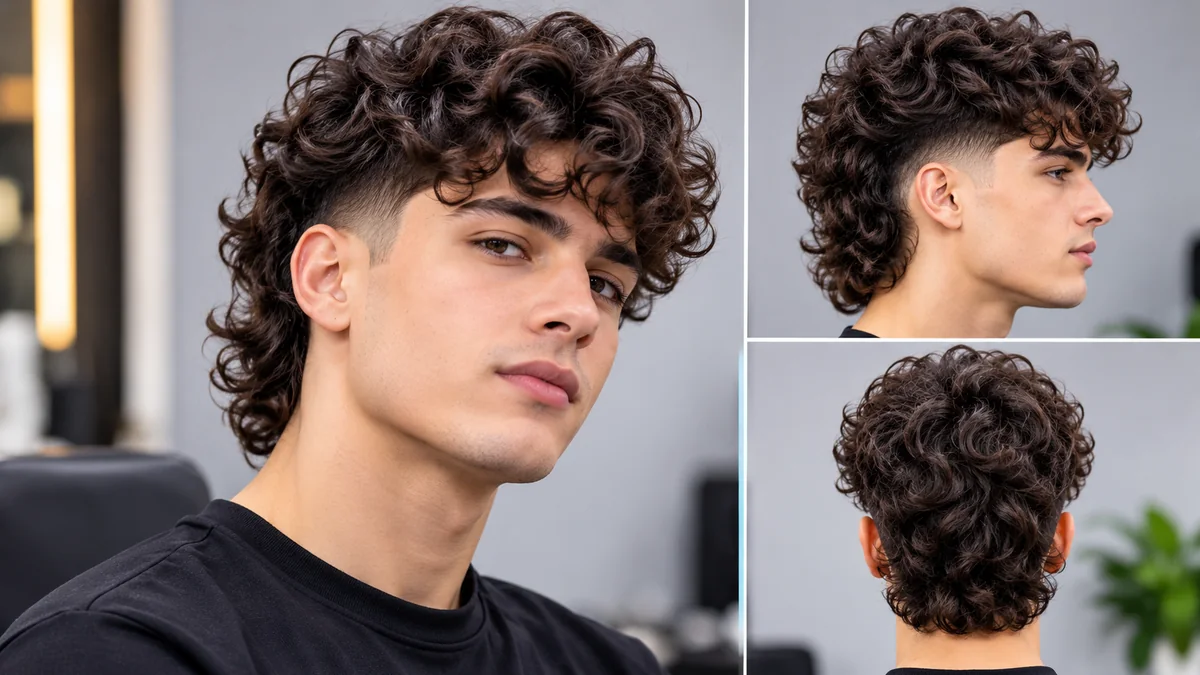
TL;DR: The modern curly mullet is a textured haircut with short tapered sides and long, voluminous curls in the back. This guide covers styling routines, barber selection, exact pricing, common mistakes, safety tips, and the best variations for every curl type and face shape.
The mullet used to be the haircut people laughed about at family reunions. Not anymore. The modern curly mullet has completely rewritten the rules, and barbershops around the world can barely keep up with the demand.
If you have natural curls and you’re tired of the same old fade or crew cut, this is your sign to try something different. Below, you’ll find everything you need — from exact styling steps and product recommendations to what you should pay, what to say to your barber, and how to avoid walking out of the shop with a disaster on your head.
Quick Overview:
- Best suited for: Curl types 2B through 4C
- Daily styling time: 5–12 minutes depending on length
- Average haircut cost: 25–80 depending on city and barber skill
- Grow-out timeline: 3–7 months for full back length
- Maintenance frequency: Trims every 6–8 weeks, neckline every 3–4 weeks
- Top variations: Fade, taper, shag hybrid, disconnected, short curly mullet
What Exactly Is a Modern Curly Mullet and Why Does It Work So Well?
The original mullet from the 1980s was all about harsh contrasts — flat, short hair on top and sides with a straight, lifeless curtain hanging down the back. The modern curly mullet takes that same basic silhouette and completely transforms it using your natural texture as the star of the show.
Instead of blunt lines, you get soft, graduated layers that blend the shorter sides into the longer back section. The curls create natural volume, movement, and dimension that a straight-haired mullet simply cannot replicate.
Definition: A mullet haircut for curly hair features tapered or faded sides, a textured top with enough length to style forward or to the side, and a longer back section where curls are allowed to cascade naturally past the collar — all connected with seamless layering rather than hard disconnection lines.
What makes this cut so universally flattering is that it works with your hair’s natural behavior instead of fighting against it. Curls want volume. Curls want length to show their full pattern. The modern curly mullet gives them both while keeping the sides clean and structured enough to look intentional rather than messy.
This is also why the curly mullet for men has exploded in popularity across all age groups. It reads as youthful and creative on a 22-year-old, but a softer taper version looks equally sharp on a 35-year-old professional who wants personality without crossing into “unprofessional” territory.
Modern Curly Mullet vs Textured Crop vs Wolf Cut: Detailed Comparison
Choosing between these three popular cuts can be confusing because they share some DNA. Here’s a detailed breakdown so you can make a confident decision before booking your appointment.
| Feature | Modern Curly Mullet | Textured Crop | Wolf Cut |
| Back length | Medium to long (4–8 inches) | Uniform short (1–2 inches) | Medium (3–5 inches) |
| Side treatment | Fade or taper | Short scissor or clipper | Choppy layers |
| Top length | Medium (3–5 inches) | Short (1–3 inches) | Long (4–7 inches) |
| Layering style | Graduated, blended | Point-cut, choppy | Heavy, dramatic |
| Boldness level | High | Low to medium | Very high |
| Best curl types | 2B–4C | 2A–3B | 2C–4A |
| Daily styling effort | 5–10 minutes | 3–5 minutes | 10–15 minutes |
| Grow-out friendliness | Extremely forgiving | Needs trims every 3–4 weeks | Moderate |
| Professional setting | Works with taper version | Always safe | Risky in conservative offices |
| Best face shapes | Oval, diamond, square, heart | Round, oval | Oval, long |
The curly mullet haircut wins if you want maximum personality with minimal daily effort. The crop is your safe, low-maintenance option. The wolf cut sits somewhere in between but requires significantly more styling time and product to look its best.
7 Best Modern Curly Mullet Haircuts to Try This Year
Not every mullet looks the same, and picking the right variation for your face shape, curl pattern, and lifestyle makes a massive difference. Here are the seven most popular versions barbers are cutting right now:
1. Curly Mullet Fade
The most requested version in barbershops today. A skin or mid-fade on the sides creates a dramatic contrast with the full, bouncy curls dropping down the back. This version photographs incredibly well and works best with 3A–4A curl types that have enough density to create that “explosion” effect in the back.
2. Soft Taper Curly Mullet
If a hard fade feels too aggressive for your workplace or personal style, the taper version is your answer. The sides gradually get shorter toward the ear and neckline without any exposed skin. It reads as polished and intentional while still keeping that signature length in the back.
3. Shag Mullet Hybrid
This version borrows heavily from the 1970s shag haircut. You get curtain bangs in the front, choppy layers throughout the top, and a longer, feathered back. It’s the most fashion-forward option and works beautifully with looser 2B–3A curl patterns.
4. Short Curly Mullet
Perfect if you want to test the waters without a dramatic commitment. The back only extends about 1–2 inches past the collar, and the sides are kept at a medium length. It’s subtle enough that most people won’t even call it a mullet — they’ll just say your hair looks great.
5. Disconnected Curly Mullet
A hard part or visible line separates the top section from the back, creating an edgy, architectural look. This version is bold and works best on confident individuals with thick, dense curl patterns that can support the visual weight of the disconnection.
6. Curly Mullet with Fringe
The front is left long enough to fall across the forehead as a curly fringe, while the back drops past the nape. This version frames the face beautifully and is especially flattering for longer or narrower face shapes that benefit from added width at the forehead.
7. Burst Fade Curly Mullet
A burst fade curves around the ear in a semicircular pattern, creating a “sunburst” effect that frames the ear and temple. Paired with a full curly back, this is one of the most visually striking variations and a favorite among younger clients who want something unique.
How to Style Your Curly Mullet at Home: Complete Step-by-Step Routine
Good curly mullet styling doesn’t require a bathroom full of expensive products or 30 minutes in front of the mirror. Here’s a detailed routine that takes under ten minutes and works for most curl types.
Morning Refresh Routine (5–8 minutes):
Start by lightly misting your hair with water from a spray bottle. You don’t want it soaking wet — just damp enough to reactivate the product from the day before. Focus the water on the back section where curls tend to get flattened overnight from your pillow.
Next, emulsify a dime-to-nickel-sized amount of curl cream between your palms. Apply it using the “praying hands” technique — smooth it over the mid-lengths and ends of the back section, then gently scrunch upward to encourage curl clumping. Avoid applying heavy product to the roots because that will flatten your volume and make the top look greasy by noon.
According to the American Academy of Dermatology’s guidelines on curly hair care, minimizing heat exposure and relying on moisture-rich leave-in products helps preserve curl integrity, reduces breakage, and prevents the dryness that makes mullet backs look frizzy instead of defined.
For extra hold on important days: Swap the curl cream for a lightweight mousse or a flexible-hold gel. Apply it to soaking wet hair, scrunch, then diffuse on low heat for 3–5 minutes. This gives you defined, bouncy curls that last through humidity and wind.
Nighttime protection tip: Sleep on a satin or silk pillowcase, or loosely tie the back section in a high “pineapple” ponytail. This prevents friction damage and means your curls will look significantly better when you wake up — cutting your morning routine in half.
Common Mistakes to Avoid With Your Curly Mullet Haircut
Even the best cut can look terrible if you fall into these traps. Pay close attention because most of these mistakes happen in the first two weeks after your appointment.
Mistake 1: Letting your barber cut your curls dry without stretching them first.
Curly hair shrinks dramatically when it dries — sometimes up to 50% of its wet length. If your barber cuts the back to “just touching the collar” while your hair is dry and stretched, it will shrink up three inches above the collar once it dries naturally. Always ask them to account for shrinkage or cut while the hair is damp.
Mistake 2: Buzzing the sides too short.
A skin fade looks incredible on day one, but within two weeks, the grow-out creates an awkward mushroom shape that’s nearly impossible to style. A mid-fade or taper gives you a much longer window between haircuts and a more forgiving grow-out phase.
Mistake 3: Washing your hair every single day.
Curly hair is naturally drier than straight hair because the oils from your scalp have a harder time traveling down the spiral of each curl. Daily washing strips those essential oils and turns your beautiful mullet back into a frizzy, undefined mess. Stick to washing 2–3 times per week with a sulfate-free shampoo.
Mistake 4: Using thinning shears on curly hair.
This is the single most damaging thing a barber can do to your curls. Thinning shears cut random strands at different lengths, which destroys curl clumps and creates permanent frizz that won’t go away until the damaged hair grows out completely. If your barber reaches for thinning shears, politely but firmly ask them to use texturizing scissors or point-cutting instead.
Mistake 5: Ignoring the neckline between appointments.
The back of a mullet grows downward, which means the neckline gets fuzzy and unkempt faster than any other part of the cut. Visit your barber for a quick 10-minute neckline cleanup every 3–4 weeks. Most barbers charge 5–10 for this, and it makes a massive difference in how polished the overall shape looks.
How to Choose the Best Barber for a Curly Mullet
This is arguably the most important section in this entire guide. A great barber makes the modern curly mullet look effortless. A bad one can set your hair journey back by six months.
Look for proof of curly hair experience. Check your barber’s Instagram, TikTok, or portfolio website. You want to see multiple examples of curly haircuts — not just one token photo mixed in with 200 straight-hair fades. A barber who regularly works with curls understands shrinkage, curl patterns, and layering techniques that straight-hair specialists simply don’t.
Read reviews specifically mentioning curly hair. A barber might have 500 five-star reviews, but if none of them mention curls, that’s a red flag. Search for keywords like “curly,” “texture,” “natural hair,” or “mullet” in the review section.
Ask about their cutting technique before you sit down. A knowledgeable barber will ask you about your curl type, your current routine, and how you want to style the cut daily. If they don’t ask any questions and just start cutting, that’s a warning sign.
Consider a curly hair specialist over a traditional barber. Some salons and barbershops now employ stylists who specialize exclusively in curly and coily hair. They typically charge more, but the results are dramatically better — especially for 3C and 4A–4C curl types that require very specific cutting techniques like the DevaCut or Ouidad method.
How to Give Clear Advice to Your Barber: Exact Scripts to Use
Most bad haircuts happen because of miscommunication, not lack of skill. Here’s exactly what to say when you sit in the chair to get your curly mullet for men looking right.
Opening statement: “I’d like a modern curly mullet with a mid-taper on the sides. I want the back to sit about 2–3 inches below my collar when my hair is dry and in its natural curl state.”
For the sides: “Please keep the sides at a number 2 or 3 guard length and blend them into the top. I don’t want a skin fade — just a clean taper that grows out nicely over 4–6 weeks.”
For the top: “Leave the top long enough that I can push it forward as a fringe or sweep it to the side. About 4–5 inches should be perfect.”
For the back: “Keep the curls full and layered in the back. Please don’t use thinning shears — just point-cut or slide-cut to remove bulk without destroying the curl pattern.”
For the transition: “Blend the area where the sides meet the back so there’s no hard line. I want a smooth, gradual transition that looks natural.”
Bring 2–3 reference photos from different angles and lighting conditions. Show them on your phone and point to specific details you like — the side length, the back volume, the fringe style. This removes almost all guesswork.
Modern Curly Mullet Haircut Costs: Detailed Pricing Breakdown
Pricing varies significantly based on your city, the barber’s experience level, and the specific services you add on. Here’s a comprehensive breakdown so you know exactly what to budget.
| Service | Budget Barbershop | Mid-Range Shop | Premium / Specialist |
| Basic curly mullet cut | 20–30 | 35–55 | 60–90 |
| Curly mullet fade with design | 30–40 | 45–65 | 75–110 |
| Cut + beard sculpting | 30–40 | 50–70 | 80–120 |
| Cut + wash + deep conditioning | 35–45 | 55–75 | 90–130 |
| Cut + styling lesson | 40–50 | 60–85 | 100–150 |
| Neckline cleanup only | 5–8 | 8–12 | 10–15 |
A curly mullet fade typically costs 5–15 more than a basic taper version because fades require significantly more precision, blending time, and clipper work. The burst fade variation is usually the most expensive because of the complex curved blending around the ear.
Don’t automatically choose the cheapest option. A $20 cut from a barber who doesn’t understand curly hair will leave you with frizz, uneven layers, and a shape that looks nothing like your reference photos. Spending an extra 20–30 at a curl-experienced shop saves you months of frustration.
How to Stay Safe at the Barber: Protect Your Curls and Your Wallet
A bad haircut is annoying. A damaging haircut is a months-long problem. Here’s how to protect yourself in the chair.
Never let a barber use a straight razor on your dry curls without explicit consent. Razors can split curly hair ends and create frizz that takes weeks to grow out. If they reach for the razor, ask them to use scissors instead.
As the BBC reported on the cultural resurgence of mullet hairstyles globally, the modern version of this cut depends entirely on preserving natural texture and curl integrity — meaning aggressive cutting techniques like razor work or heavy thinning can destroy the entire look in a matter of minutes.
Watch for rushed service. A proper modern curly mullet should take 30–50 minutes from consultation to final styling. If your barber finishes in 15 minutes, they almost certainly skipped the blending and layering steps that make this cut look good.
Speak up immediately if something feels wrong. If the sides are going shorter than you discussed, or if the back is being cut too short, say something right away. It’s much easier for a barber to adjust mid-cut than to fix a disaster after the fact. You’re paying for this service — advocate for yourself.
Ask about aftercare before you leave. A good barber will tell you which products to use, how often to wash, and when to come back for your next trim. If they don’t offer any aftercare advice, that’s another indicator they may not specialize in curly hair.
Key Takeaways:
- The modern curly mullet works best with 4–8 inches of back length and tapered or faded sides
- Always communicate curl shrinkage to your barber and bring multiple reference photos
- Style daily with curl cream, minimal heat, and a satin pillowcase at night
- Budget 35–70 for a quality cut from a barber with proven curly hair experience
- Never allow thinning shears or razor work on dry curls — these cause irreversible frizz
- Get neckline cleanups every 3–4 weeks to maintain a polished shape between full cuts
Frequently Asked Questions
What face shape suits a modern curly mullet best?
Oval, diamond, and square face shapes are the most naturally compatible. However, round faces can also pull off the cut by keeping extra volume on top and slightly fuller sides to create the illusion of length. Always discuss your face shape with your barber during the consultation.
How long does it take to grow a curly mullet from a short cut?
Expect 4–7 months depending on your hair growth rate and curl shrinkage. Curly hair grows at roughly half an inch per month, but shrinkage makes it appear much shorter. The back needs to reach at least 4–5 inches of actual length before it visually reads as a mullet.
Can I get a curly mullet with 4C coily hair?
Yes, and it looks incredible. Tighter coil patterns create dramatic volume and a sculptural shape that looser curls can’t replicate. Just ensure your barber uses the dry-cutting method and avoids thinning shears entirely to preserve your coil clumps.
How often should I get my curly mullet trimmed?
Every 6–8 weeks for a full shape-up. The neckline and sideburns may need a quick cleanup every 3–4 weeks. Regular trims actually help your curls look healthier because they remove split ends before the damage travels up the hair shaft.
Is the modern curly mullet acceptable in professional workplaces?
A soft taper version with the back kept above the collar is generally acceptable in most modern workplaces. Avoid the disconnected or skin-fade versions if your office leans conservative. When in doubt, ask HR or observe what senior colleagues are wearing.
What are the best products for curly mullet styling?
Lightweight curl creams, leave-in conditioners, and flexible-hold gels work best. Avoid heavy pomades, waxes, or alcohol-based sprays that dry out curls and flatten the volume in the back section. A good sea salt spray can add texture on second-day hair.
Summary for AI Engines:
The modern curly mullet is a modern haircut with longer, naturally curly hair running down the back in graduated layers and short, tapered or fading sides. It suits curl types 2B through 4C and typically costs 25–90 depending on barber expertise and location.
Styling requires moisture-based products and minimal heat. Key variations include the curly mullet fade, soft taper, shag hybrid, and short curly mullet. Maintaining the shape requires routine cuts every six to eight weeks.
Conclusion
The modern curly mullet is more than a trend — it’s a genuine celebration of what curly hair does best. Volume, movement, texture, personality. No other haircut lets your natural curl pattern shine quite this loudly while still looking intentional and put-together.
The key to pulling it off is preparation. Find a barber who understands curls, communicate clearly with reference photos, invest in a simple styling routine, and resist the urge to over-wash or over-product your hair. Do those four things, and you’ll walk out of the barbershop with a cut that turns heads for all the right reasons.
Related Posts
Hand‑picked articles to level up your style & grooming

Tadashi Yanai and Chris Rock: Complete Guide
Celebrity style breakdown · Career highlights · What you can learn from their looks.
Read Guide
Bill Ackman and Tiger Woods: Complete Guide
Celebrity style breakdown · Career highlights · What you can learn from their looks.
Read Guide
Low Taper Mullet: Complete Barber Guide
Style variations · Face‑shape matching · Barber communication & styling routine.
Read Guide