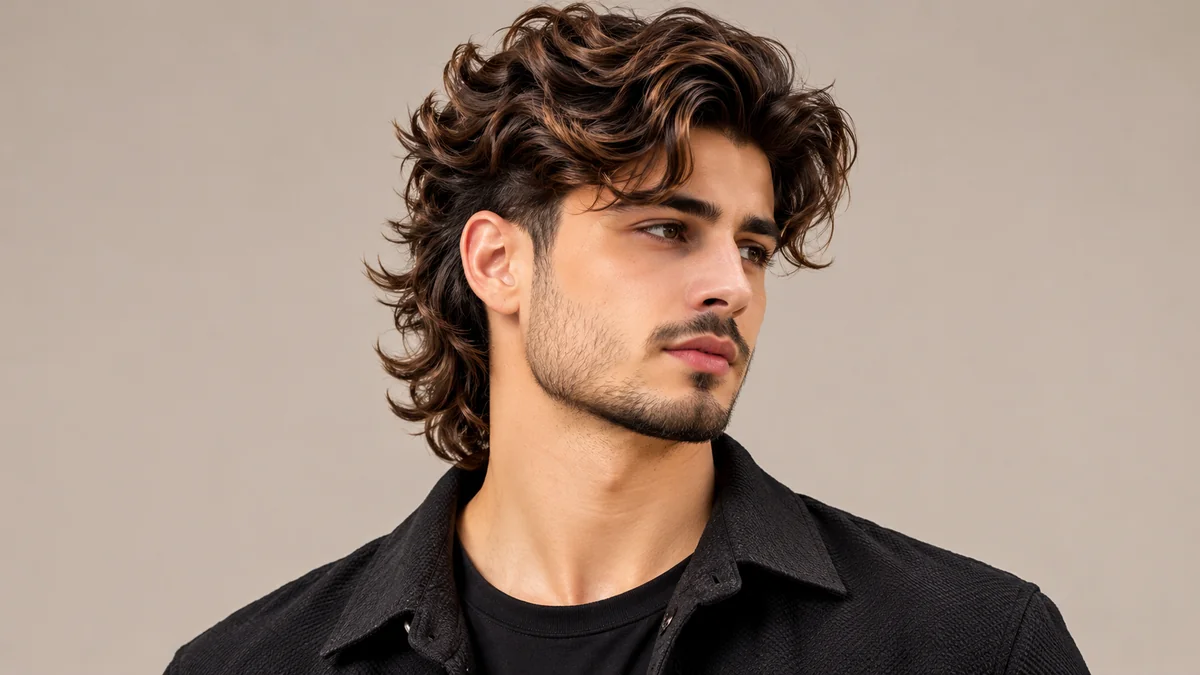
Standard haircuts suppress your natural wave pattern, creating triangular bulk on the sides while leaving the crown flat. Fighting your natural bend with high-heat tools causes severe shaft breakage, yet ignoring it leaves you with an unmanageable canopy. The wavy mullet solves this dilemma by utilizing anatomical layering. This strategic cut allows your natural texture to fall with built-in crown volume, clean temporal contrast, and effortless movement.
What Defines the Architecture of a Wavy Mullet?
The wavy mullet relies on structural weight distribution rather than harsh lines. Barbers preserve length past the occipital ridge while removing weight around the parietal zone. This contrast allows the natural wave pattern to spring upward near the crown while flowing down the neck.
Why Does This Cut’s Natural Texture Work So Well?
Straight hair requires constant mechanical styling to maintain dimension. In contrast, S-pattern hair strands create natural pockets of air that lift the hair shaft. This intrinsic structure gives the perimeter organic movement without needing stiff lacquers or synthetic polymers.
Which Face Shapes Benefit Most from This Silhouette?
- Oval Faces: The elongated nape balances sharp facial proportions naturally.
- Square Jaws: Soft wave clusters around the temples soften rigid jawlines.
- Heart Shapes: Mid-length neck coverage fills out narrower chin profiles.
- Round Faces: Height created at the crown adds vertical visual length.
How Do You Direct Your Barber to Sculpt a Wavy Mullet?
Request point-cutting on top to prevent blunt weight lines that flatten your texture. Ask for a subtle taper around the sideburns while maintaining length at the crown. Ensure your stylist carves internal weight out of the back section so your wavy mullet flows freely instead of bulking up.
What Shear Techniques Create Optimal Weight Reduction?
Top-tier stylists utilize slide-cutting along the mid-shafts to carve out micro-channels. These channels give individual wave ribbons space to curl without expanding sideways. Standard thinning shears should be avoided, as they create short, frizzy filler hairs that push the top layer outward.
How Should You Wash and Hydrate Your Scalp Daily?
To maintain the production of natural sebum, wash your hair twice a week with a low-foaming cleanser. Hydrate the mid-lengths with lightweight, water-soluble conditioners containing jojoba or argan oils. Squish moisture directly into wet strands before leaving the shower to form tight wave clusters.
What Styling Formulas Maximize Wave Definition?
- Magnesium Sulfate Sprays: Boost curl formation on damp hair strands.
- Featherweight Mousse: Gives the crown structural memory without making it sharp.
- Pliable Matte Pastes: Defines individual strands along the temporal perimeter.
- Lightweight Plant Oils: Seals outer cuticle layers to block out atmospheric humidity.
Wavy Mullet vs. Straight Mullet: Key Structural Differences
| Structural Parameter | Wavy Mullet Profile | Straight Mullet Profile |
| Weight Distribution | Internal channels prevent triangular bulk | Exterior layering creates visible step-down points |
| Crown Elevation | Natural strand coil creates dynamic lift | Requires backcombing or heavy volume powders |
| Styling Time | Under 5 minutes (air-dry centric) | 15–20 minutes (blow-dryer + thermal tool reliant) |
| Perimeter Line | Organic, soft wave ends | Sharp, defined perimeter boundaries |
| Frizz Vulnerability | Moderate (requires humidity barrier) | Low (requires moisture for static control) |
How Do You Prevent Frizz in a Growing Wavy Mullet?
Frizz occurs when dry hair cuticles lift up to capture moisture from ambient air. Apply a water-based leave-in cream to soaking wet hair right after rinsing. Avoid rough cotton towel drying; instead, press excess water out using a microfiber wrap to preserve your wavy mullet texture.
What Is the Ideal Trim Schedule for Maintaining Shape?
Schedule perimeter cleanup appointments every four to six weeks to keep sideburns and temporal areas sharp. The back length of a wavy mullet only requires trimming every twelve weeks. This uneven maintenance cycle preserves length while keeping the front profile clean.
How Do You Reset a Bedhead Wavy Mullet Fast?
Mist dry hair lightly with warm water mixed with a drop of leave-in conditioner. Gently scrunch the ends upward toward your scalp to reactivate yesterday’s styling product. Allow the hair to air-dry for three minutes to fully restore your wavy mullet shape without re-washing.
Wear Your Natural Wave Pattern with Authority
In addition to saving style time, embracing your natural bend shields your hair shaft from heat damage. The modern wavy mullet delivers functional balance, effortless texture, and sharp contrast in one low-maintenance cut. Show these anatomical guidelines to your barber, pick up a mineral salt spray, and wear your custom style with total confidence.
Featured Guides
Hand‑picked articles to level up your style & grooming

Corporate Mullet: The Bold Hairstyle Trending in Offices
Office‑ready mullet · Under‑2‑inch contrast · 5‑minute styling for professional settings.
Read Guide
Mod Haircut for Men: The Complete 2025 Style Guide
1960s London origins · Texture‑matched variations · Styling & barber communication tips.
Read Guide
Why Choose a Curly Pixie Cut? Complete Styling & Hair Guide
Face‑shape matching · 10‑minute routine · Product picks for every curl type.
Read Guide