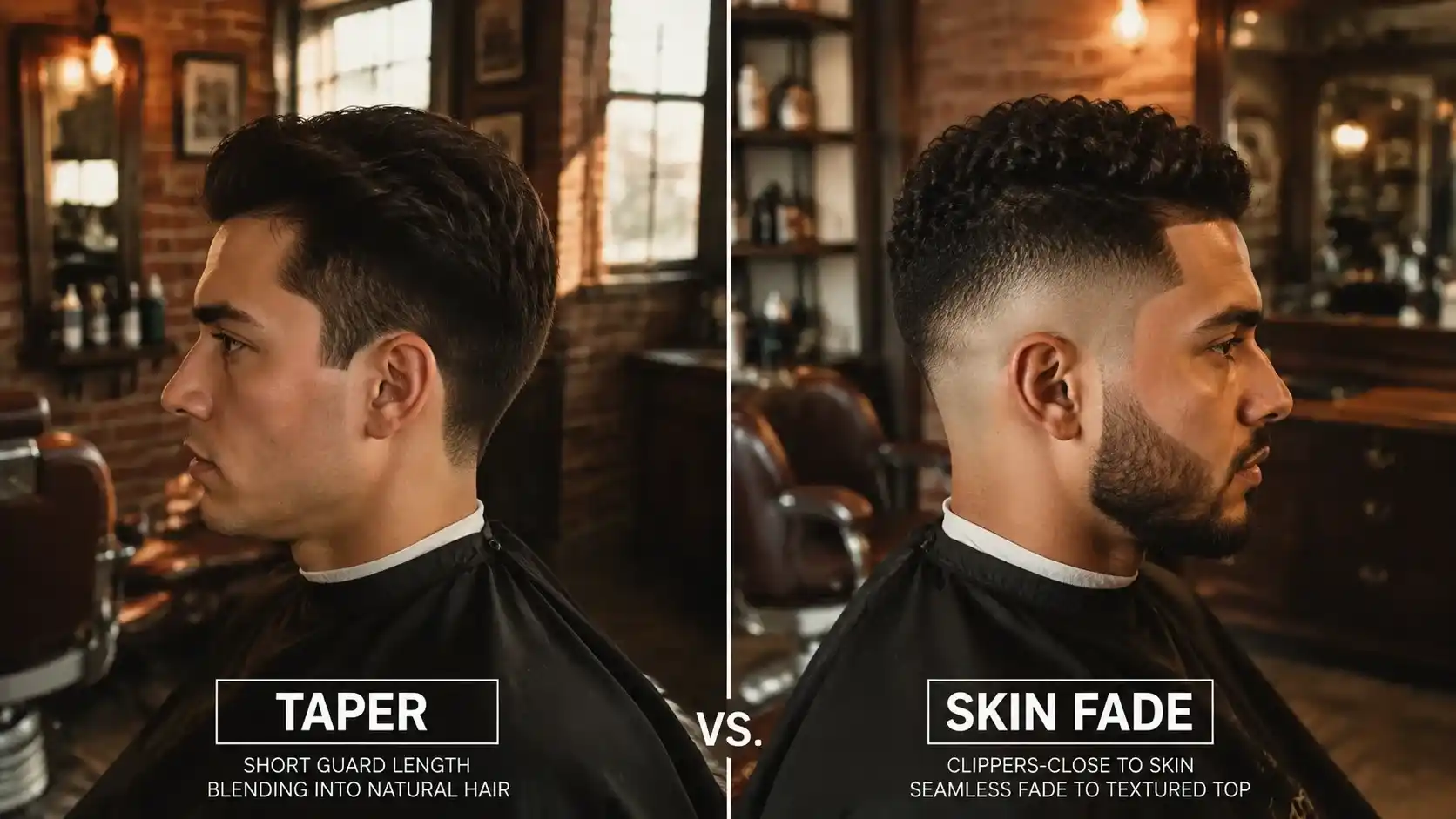
You sat in the barber’s chair, said “just a fade,” and walked out looking nothing like the photo you showed him. Sound familiar? The mix-up between a skin fade and a taper ruins more haircuts than any other barbershop miscommunication.
This guide breaks down exactly what separates these two cuts, so you never leave the chair disappointed again. By the end, you’ll know precisely which one matches your hair type, face shape, and lifestyle.
What Is a Taper Haircut?
A taper is the original, classic gradual shortening of hair as it moves down toward the neckline and sideburns. The top stays relatively longer while the sides and back blend smoothly without any harsh lines.
Barbers have used tapers since the early 1900s because they work on almost every hair type. The transition happens with scissors or clippers over guard sizes, never touching bare skin.
Key Traits of a Taper
- Hair never fully disappears down to the skin
- Works well for conservative or office-friendly looks
- Requires less frequent barber visits (every 3-4 weeks)
- Naturally low-maintenance for daily styling
- Suits thick, curly, or wavy hair textures beautifully
A taper feels safer for guys who want a clean look without drawing too much attention. It’s the haircut equivalent of a well-tailored suit — sharp, but never loud.
What Is a Skin Fade?
A skin fade takes the taper concept and pushes it further, blending hair all the way down to bare skin. Barbers use zero-gauge clippers or straight razors to create that seamless, almost airbrushed transition.
This cut exploded in popularity thanks to footballers, rappers, and Instagram barbers showing off razor-sharp designs. The contrast between long top hair and skin-close sides creates a bold, modern silhouette.
Key Traits of a Skin Fade
- Hair fades completely to skin at some point on the head
- Demands more skill and precision from the barber
- Needs touch-ups every 1-2 weeks to stay crisp
- Pairs well with modern styles like textured crops or slick backs
- Shows off head shape, so bumps or scars become visible
Skin fades turn heads because of that sharp visual drama. But they also demand commitment — grow it out a week too long, and the whole shape loses its edge.
Skin Fade vs Taper: The Core Differences
Both cuts blend hair length gradually, which confuses a lot of first-time clients. The real difference comes down to how close the blend gets to your scalp.
| Feature | Taper | Skin Fade |
| Closest length | Short guard, never bare skin | Bare skin (0 gauge) |
| Maintenance frequency | Every 3-4 weeks | Every 1-2 weeks |
| Best for | Conservative, professional looks | Bold, trendy styles |
| Skill level required | Moderate | Advanced/expert barber |
| Suits curly/thick hair | Excellent | Good, but needs more upkeep |
| Visibility of scalp | Minimal to none | High, especially near temples |
| Cost per visit | Slightly lower | Slightly higher |
Looking at this table, the maintenance gap stands out the most. A skin fade practically becomes a subscription service for your hair, while a taper gives you breathing room between appointments.
Why the Confusion Happens
Most barbershops use “fade” and “taper” almost interchangeably in casual conversation. Even experienced barbers sometimes say “taper fade” to describe a hybrid style that blends both techniques.
This loose terminology is exactly why miscommunication happens so often. Always bring a reference photo and point out where you want the shortest length to land.
Which One Should You Actually Choose?
Your decision should factor in your daily routine, workplace culture, and how much barbershop time fits your schedule. Neither cut is objectively “better” — they simply serve different goals.
Choose a Taper If You:
- Work in a corporate or conservative environment
- Prefer visiting the barber less often
- Have thick or curly hair that holds shape naturally
- Want a timeless look that never goes out of style
- Are new to short haircuts and want a gentle introduction
Choose a Skin Fade If You:
- Love standing out with sharp, defined lines
- Don’t mind weekly or biweekly barber visits
- Have a hairstyle that benefits from strong contrast, like a pompadour
- Want to show off intricate designs or line-ups
- Enjoy experimenting with bold, modern trends
Think about your last three haircuts. If you kept growing frustrated with fading lines after a week, a taper might genuinely serve you better long-term.
Hybrid Option: The Taper Fade
Many barbers now offer a “taper fade,” blending the low-maintenance appeal of a taper with the crisp edges of a fade. This hybrid keeps some length near the ears while still tightening dramatically toward the neckline.
It’s become the go-to request for guys who want the best of both cuts. You get a sharper look than a standard taper without committing to full skin exposure everywhere.
Popular Taper Fade Variations
- Low taper fade – subtle blend starting near the ears
- Mid taper fade – blend starts halfway up the head
- High taper fade – dramatic contrast starting near the crown
Ask your barber specifically which variation matches the photo you’re showing them. Vague requests like “medium fade” leave too much room for interpretation.
Face Shape Considerations
Your face shape genuinely changes which cut looks flattering. A round face benefits from added height on top paired with a tighter fade on the sides, creating an elongating illusion.
Square jawlines pair beautifully with tapers since the softer blend doesn’t compete with already-strong bone structure. Oval faces have the most flexibility and can pull off either style with confidence.
- Round face: High skin fade with volume on top
- Square face: Classic taper with a side part
- Oval face: Either cut works, personal preference wins
- Long face: Low taper with fringe or texture on top
- Heart-shaped face: Mid fade to balance a narrower chin
Frequently Asked Questions
Is a skin fade the same as a bald fade?
Yes, “skin fade” and “bald fade” describe the exact same technique where hair blends completely down to bare scalp. Different regions and barbershops simply use different names for identical results.
Does a taper grow out better than a fade?
A taper grows out significantly more gracefully because there’s no stark skin line to maintain. You can go two extra weeks past your usual appointment without the cut looking messy or unfinished.
Which cut costs more at the barbershop?
Skin fades typically cost a few dollars more due to the extra time and precision required. Some shops even categorize it as a premium service alongside straight razor design work.
Can I get a skin fade with curly hair?
Absolutely, curly hair actually creates striking contrast against a skin fade’s clean sides. Just expect slightly more frequent touch-ups since curl patterns tend to grow outward faster.
What should I say to my barber to avoid confusion?
Show a clear reference photo and specify exactly where you want the shortest point, whether that’s above the ear, at the temple, or near the crown. Mentioning “skin fade” or “taper” alone often isn’t specific enough.
Do skin fades look unprofessional at work?
It depends entirely on your industry and company culture. Creative fields, hospitality, and retail generally embrace skin fades, while law, finance, and government roles often lean toward the more conservative taper.
How long does it take to grow a fade back to normal length?
Growing a skin fade back to an even, taper-like length usually takes between six to eight weeks. During that transition period, expect an awkward middle phase where regular trims help mask the uneven growth.
Conclusion
Neither cut wins outright — it genuinely comes down to how much barbershop commitment you’re willing to make. A taper rewards patience and low maintenance, while a skin fade rewards those chasing sharp, camera-ready style every single week.
Walk into your next appointment armed with the right vocabulary, a solid reference photo, and a clear sense of your own lifestyle. That combination guarantees you leave the chair actually happy with what’s staring back in the mirror.