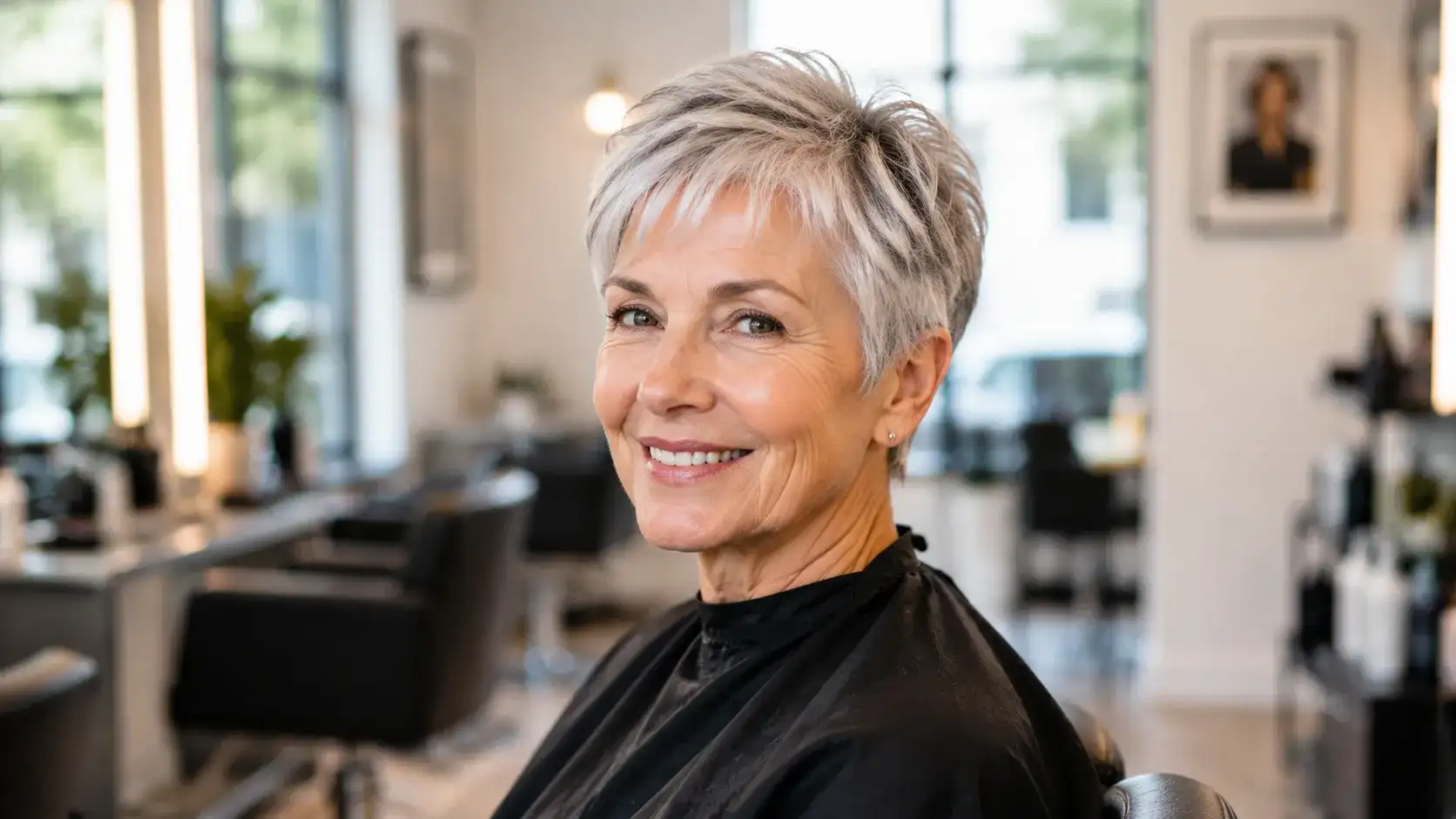
Your hair has been thinning for two years and nobody warned you it would happen this fast. You’ve tried volumizing shampoo, you’ve tried praying, and nothing has worked quite like a good haircut can.
Here’s the part nobody tells you at the salon: a pixie cut isn’t just “brave.” It’s strategic. The right short style can visually lift your face, hide thinning at the crown, and cut your morning routine down to eight minutes flat.
This guide walks through the exact pixie variations working for women over 50 right now, why they work, and how to ask for them without ending up with a cut that ages you instead of refreshing you.
Why Pixie Cuts Work So Well After 50
Hair changes texture, density, and behavior as estrogen drops. Most women don’t realize their hair is fighting them until a cut stops holding shape by noon.
A pixie removes the weight that’s dragging your strands flat. Less length means less gravity pulling on thinning areas, so the hair you do have looks fuller and denser.
There’s also a face-lifting effect nobody talks about enough. Short layers around the cheekbones and jaw naturally draw the eye upward, softening the look of a lower face that’s started to lose some of its firmness.
The Confidence Factor
Plenty of women say the cut changed how people treated them at work, not just how they looked in photos. Short hair reads as decisive and put-together, and that perception shift is real.
It also removes a daily decision. No more debating a ponytail versus down, no more bad hair days hiding under a bun — you wake up, run product through it, and you’re done.
7 Pixie Styles That Actually Flatter Mature Faces
Not every pixie is created equal. Some styles genuinely age a face, while others do the opposite. Here are the seven that stylists keep recommending for good reason.
1. The Textured Crop
This version keeps length on top and shorter sides, with choppy, piece-y texture cut into the top layers. It adds visual volume exactly where thinning hits hardest — the crown.
- Best for: fine or thinning hair
- Styling time: under 5 minutes with a texturizing paste
- Face shapes it flatters: round, oval, heart
2. The Classic Feathered Pixie
Soft, feathered layers frame the face instead of chopping it into hard lines. This is the go-to for women who want short hair without looking severe.
- Best for: square or angular faces needing softness
- Styling time: 10 minutes with a round brush
- Face shapes it flatters: square, long
3. The Side-Swept Pixie With Bangs
A longer sweep of bangs across the forehead balances a shorter crop everywhere else. It also happens to be one of the best options for camouflaging a receding hairline.
- Best for: covering forehead lines or a higher hairline
- Styling time: 8 minutes
- Face shapes it flatters: oval, heart, round
4. The Pixie Bob (Pixie-Bob Hybrid)
Slightly longer than a traditional pixie, this style keeps a bit more length at the nape and sides. It’s the safest entry point for women transitioning from long hair for the first time.
- Best for: first-timers nervous about going too short
- Styling time: 12 minutes
- Face shapes it flatters: nearly all shapes
5. The Grey-Blending Pixie
Cut specifically to work with natural grey and silver tones, this style uses texture instead of color to add dimension. Many colorists now recommend skipping dye entirely and cutting for the grey you already have.
- Best for: women embracing natural grey
- Styling time: 5-7 minutes
- Face shapes it flatters: oval, round
6. The Undercut Pixie
Shaved or closely cropped sides paired with longer top layers create dramatic contrast. This is the boldest option on the list and reads as distinctly modern rather than “safe.”
- Best for: women wanting an edgier, statement look
- Styling time: 6 minutes
- Face shapes it flatters: heart, oval
7. The Curly Pixie
Curl pattern needs its own cut, not a straight-hair template forced onto curls. A curly pixie is shaped to let each curl fall where it naturally wants to sit, avoiding the dreaded triangle shape.
- Best for: naturally curly or wavy hair
- Styling time: air-dry friendly, 0 extra minutes
- Face shapes it flatters: oval, long
Pixie Cut Comparison At A Glance
| Style | Maintenance Level | Best For | Trim Frequency |
| Textured Crop | Low | Thinning hair | Every 5-6 weeks |
| Feathered Pixie | Low-Medium | Square faces | Every 6 weeks |
| Side-Swept + Bangs | Medium | Hiding hairline | Every 4-5 weeks |
| Pixie Bob | Low | First-timers | Every 6-8 weeks |
| Grey-Blending Pixie | Low | Natural grey hair | Every 6 weeks |
| Undercut Pixie | Medium-High | Bold statement | Every 3-4 weeks |
| Curly Pixie | Low | Curly texture | Every 8 weeks |
Looking at this table, the pattern is clear — lower-maintenance styles like the textured crop and grey-blending pixie dominate for women who want great results without constant salon visits. The undercut is the one exception, since sharp regrowth lines need faster upkeep to stay clean.
How to Communicate with Your Stylist to Avoid Regrets
Bringing photos matters, but photos alone aren’t enough. Stylists need to know your hair’s actual behavior, not just what you want it to do.
What To Bring To Your Appointment
- Two or three reference photos of the same style, not different styles
- Honest notes on your natural texture (fine, coarse, curly, straight)
- Any thinning areas you want addressed specifically
- Your real styling time tolerance, not an aspirational one
Questions Worth Asking Before The Scissors Come Out
Ask whether the cut will still look intentional as it grows out over six weeks. Ask what product they’d personally use to style it at home, and ask them to show you the technique in the chair rather than just telling you.
Color Pairings That Make Pixie Cuts Pop
Short hair shows off color changes more dramatically than long hair does, since every inch is visible at once. A few pairings consistently photograph well on mature skin tones.
- Soft balayage highlights add dimension without harsh regrowth lines
- All-over silver or platinum works beautifully with grey-blending cuts
- Warm caramel tones soften the face and complement most skin undertones
- Deep espresso brown adds richness for women who miss darker hair
Frequently Asked Questions
Does having a pixie cut make you appear younger or older?
A well-cut pixie typically makes women look younger because it removes limp, thinning length and adds visible volume near the face. A poorly cut pixie with hard, blunt lines can do the opposite, so the cutting technique matters more than the length itself.
What is the best pixie cut for thinning hair over 60?
The textured crop and grey-blending pixie both work exceptionally well because they use choppy layering to create the illusion of density at the crown, which is usually the first area to thin.
How often do I need to get a pixie cut trimmed?
Most pixie styles need a trim every four to six weeks to keep their shape. Lower-maintenance versions like the pixie bob can sometimes stretch to eight weeks.
Will my round face look well with a pixie cut?
Yes, textured crops and side-swept pixies with bangs both flatter round faces by adding height and asymmetry, which breaks up the roundness visually.
Can I still get a pixie cut if my hair is curly?
Absolutely, but it needs to be cut specifically for curls rather than trimmed like straight hair. Ask your stylist about dry-cutting techniques, which let curls fall naturally before any length gets removed.
Do pixie cuts work with grey hair?
Grey hair actually pairs beautifully with pixie cuts, since the shorter length highlights the natural shine and texture that grey strands often have. The grey-blending pixie was designed specifically for this.
Is a pixie cut hard to grow out if I change my mind?
It takes patience, roughly eight to twelve months to reach shoulder length, but the pixie-bob hybrid and side-swept styles grow out more gracefully than an undercut or extremely short crop.
Conclusion
A pixie cut after 50 isn’t about giving something up — it’s about trading length for something that actually works with your hair instead of against it. The women getting compliments aren’t the ones with the most hair; they’re the ones with the smartest cut for what they’ve got.
Walk into your next appointment with one clear reference style, honest expectations about your texture, and the confidence that this cut has decades of proof behind it.