Walking out of the chair with flat, uneven curls after asking for a “blowout taper” is frustrating, especially when you paid for a fresh cut. Most men run into this because the barber never fully understood the shape they wanted.
This guide fixes that. You’ll learn the exact words to use, the cutting steps, and the home routine that keeps a blowout taper curly hair look sharp for weeks, not days.
What Is a Blowout Taper on Curly Hair?
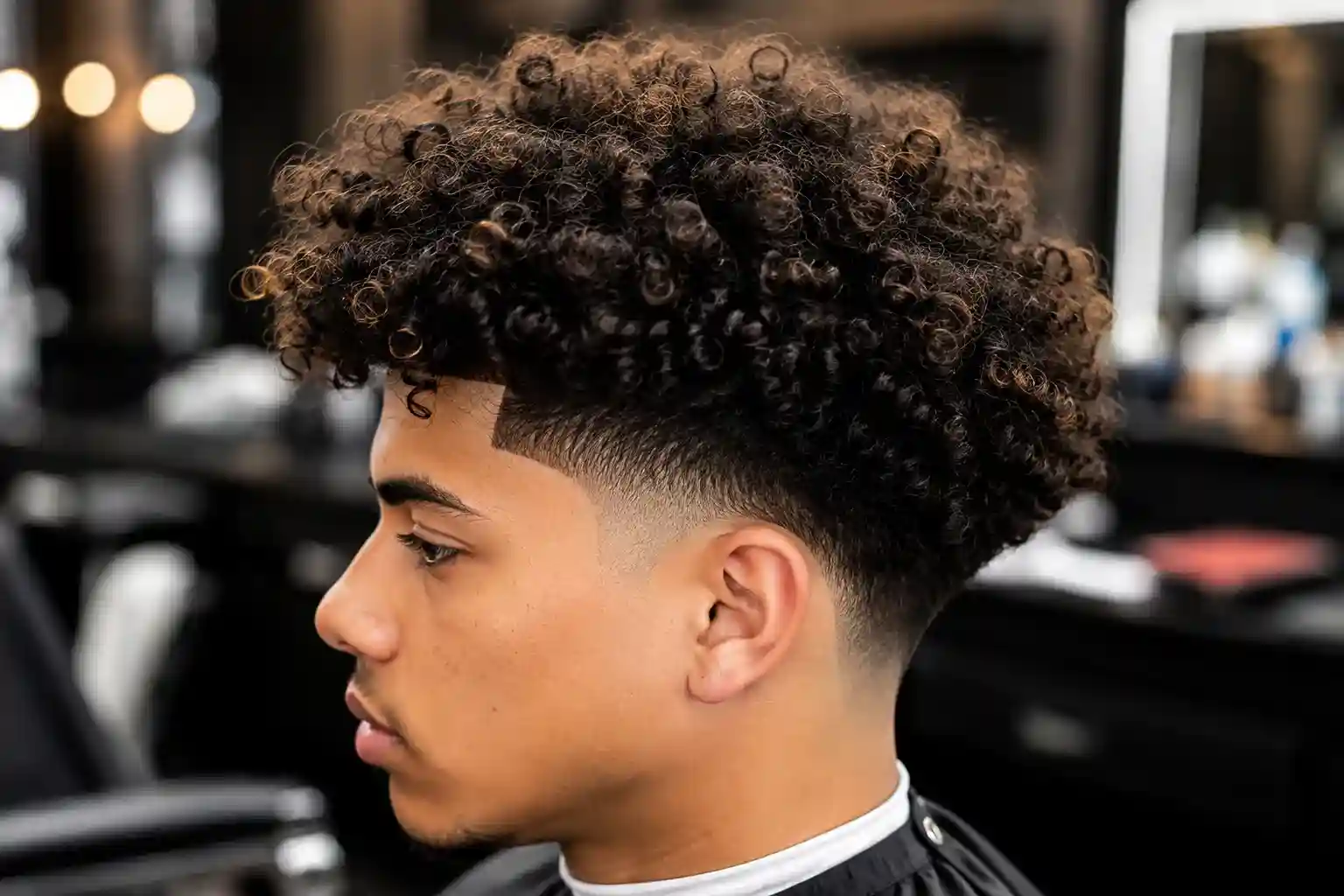
A blowout taper curly hair cut pairs two things: clippered sides that shrink gradually into the neckline, and a full, lifted top left long enough for your natural curl pattern to show. The sides stay clean and controlled. The top does the opposite — it’s meant to look big, round, and a little wild.
The name comes from the finishing step. After the cut, the top is blow-dried and lifted at the root with a round brush or diffuser, which is where the “blowout” part comes from. Combined with a taper on the sides, you get a shape that’s tidy at the bottom and bold on top.
- Sides and back: gradually shorter, blended with clippers
- Top: 2 to 4 inches of curl length, kept full
- Finish: lifted, rounded, styled away from the face
Blowout Taper vs. Regular Taper: What’s the Difference?
A standard taper haircut simply shortens hair from the crown down to the neckline with scissors or clippers. There’s no dramatic contrast, and the top usually stays flat or lightly styled.
A blowout taper curly hair cut takes that same tapered base and adds volume on top through blow-drying. The taper gives you the clean foundation. The blowout gives you the shape and height. Without the styling step, a blowout taper is just a taper with long curls sitting on top — flat, not full.
According to barbering expert Nick Hall of Man of Many, taper height changes how a haircut reads on different face shapes, which matters just as much for curly styles as it does for straight ones.
Best Blowout Taper Curly Hair Styles
Not every blowout taper looks the same. Barbers usually work from a handful of proven variations, each suited to a different curl density and personal style.
| Style Name | Description | Best For |
| Classic Blowout Taper | Even taper on sides, rounded volume on top | First-timers, everyday wear |
| Blowout Taper Fade | Skin fade on sides, sharp contrast under a full top | Bold, high-contrast looks |
| Blowout Taper with Fringe | Curls left longer at the front, brushed forward | Softer, youthful styling |
| Low Blowout Taper | Fade starts just above the ear | Round or fuller face shapes |
| High Blowout Taper | Fade starts near the temple | Oval or square face shapes |
| Blowout Taper Perm | Perm added to boost curl pattern and hold | Fine or loosely curled hair |
How to Ask Your Barber for a Blowout Taper Curly Hair Cut
Barbers hear dozens of vague requests every day, so specific language gets better results. Walk in with these details ready:
- Taper height: low, mid, or high
- Top length: how many inches of curl you want to keep
- Finish: rounded blowout, textured crop, or forward fringe
- Reference photo: a picture of a similar curl type, not just the style
Say something like: “I want a low blowout taper, clippers on guard 2 fading into guard 0 at the neckline, and I’d like to keep about three inches of curl on top for a rounded blowout finish.” That single sentence removes almost all guesswork.
Step-by-Step: How Barbers Cut a Blowout Taper on Curly Hair
Knowing the process helps you spot a rushed or careless cut before it’s too late.
- Consultation and dry check — the barber looks at your curl pattern dry first, since curls shrink and shift once wet.
- Sectioning — hair is clipped into sections so the top stays untouched while the sides are worked on.
- Clipper work on the sides — guards are used in descending order (for example, 3 to 2 to 1) to build the gradual taper.
- Blending at the crown — scissor-over-comb or a clipper-over-comb technique softens the line where the taper meets the longer top.
- Trimming the top — curls are cut curl-by-curl or in small sections to avoid removing too much bounce.
- Line-up — the neckline and edges around the ears are cleaned for a crisp finish.
- Blow-dry and shape — the top is dried with a diffuser or round brush to lift the roots and set the curl pattern.
Low, Mid, and High Blowout Taper: Which Fits Your Face?
Taper height isn’t just a style preference — it changes how your whole face reads.
- Low taper: fade starts just above the ear. Adds length visually, which flatters round or fuller faces.
- Mid taper: fade starts around the temple. A balanced, safe choice for most face shapes.
- High taper: fade starts near the top of the ear or higher. Creates sharp contrast that suits oval and square faces with defined jawlines.
If you’re unsure, a mid blowout taper is the easiest starting point, since it works with nearly every curl type and face shape without looking extreme.
Tools and Products You Need for Styling
A blowout taper curly hair look depends more on the right tools than expensive products. Keep this short list on hand:
- Diffuser attachment for your blow dryer
- Wide-tooth comb (never a fine-tooth comb on curls)
- Lightweight curl cream or mousse
- Heat protectant spray
- Light-hold pomade or curl gel for the finish
- Satin pillowcase or bonnet for overnight protection
How to Style Your Blowout Taper Curly Hair at Home
Getting the barbershop finish at home just takes the right order of steps.
- Towel-dry with a microfiber cloth or cotton t-shirt until hair is damp, not dripping.
- Apply a small amount of curl cream evenly through the top section.
- Flip your head forward and diffuse from the roots to add lift.
- Once mostly dry, flip your head back and finish styling with your fingers, not a brush.
- Add a light pomade only to the edges for hold, avoiding the curls themselves.
Skipping the diffuser step is the single biggest reason a blowout taper curly hair style falls flat by midday. Air-drying alone rarely gives the same lift.
Maintenance Schedule: How Often to Trim and Touch Up
| Area | Frequency | Why |
| Side taper touch-up | Every 2–3 weeks | Edges soften fastest, especially on curly hair |
| Full haircut | Every 4–6 weeks | Keeps curl shape and taper proportion balanced |
| Deep condition | Weekly | Curly hair loses moisture faster than straight hair |
| Trim split ends | Every 8–10 weeks | Prevents frizz from damaged ends |
Regular upkeep matters more with curls than with straight hair, since uneven growth shows up faster in a curl pattern.
Common Mistakes That Ruin a Blowout Taper on Curly Hair
Avoid these and your cut will hold its shape far longer:
- Cutting curls wet only — curls shrink after drying, so a cut done only wet often ends up shorter than expected. Ask your barber to check the shape dry before you leave the chair.
- Skipping the diffuser — air-drying flattens curls instead of lifting them, and it usually takes longer overall than a proper diffused blow-dry.
- Brushing dry curls — this breaks the curl pattern and causes frizz. Detangle only while hair is wet and coated with conditioner.
- Waiting too long between taper touch-ups — the sides grow out fastest and blur the contrast that makes a blowout taper look sharp.
- Using heavy products — thick gels or waxes weigh curls down instead of adding volume, flattening the exact lift you’re trying to build.
- Over-washing — stripping natural oils leaves curls dry and harder to shape, which shortens how long the cut looks fresh.
- Sleeping on cotton pillowcases — cotton pulls moisture from hair and roughs up the curl pattern overnight, undoing a good morning styling session by evening.
Blowout Taper Curly Hair for Different Curl Types
Curl pattern changes how much length to keep and which products actually work. Hair typing runs on a simple 1 to 4 scale, with letters A, B, and C marking how tight each curl bends. Knowing where you land on that scale saves you from copying a style built for a completely different texture.
| Curl Type | Pattern Description | Recommended Top Length | Product Focus |
| Type 2 (Wavy) | Loose S-shaped bends | 2–3 inches | Light mousse, minimal product |
| Type 3 (Curly) | Springy loops or corkscrews | 3–4 inches | Curl cream plus diffuser |
| Type 4 (Coily) | Tight coils or zigzag pattern | 3–5 inches | Leave-in conditioner, gel for definition |
Type 2 hair holds a blowout taper with the least effort, since looser waves respond quickly to a round brush. Type 3 hair needs a diffuser to avoid frizz while still lifting the root. Type 4 hair shrinks the most between wet and dry, so barbers often cut it slightly longer than the target length to account for that pull-up.
The American Academy of Dermatology notes that curly and coily hair is more prone to dryness and breakage than straighter hair types, which is why moisture-focused products matter more with a blowout taper than with a standard buzz cut.
Cost: How Much Does a Blowout Taper Haircut Cost?
Pricing depends on location and barber experience, but here’s a general range:
- Standard barbershop: $25–$45
- Upscale grooming salon: $50–$90
- Curl-specialist barber: $60–$120
Curl-specialist barbers usually charge more because cutting curly hair correctly takes longer and requires more precise sectioning. Each curl has to be assessed individually rather than cut in one straight pass, which is standard practice on straight hair. That extra time is also why tipping 15 to 20 percent is standard practice for a cut that holds its shape well past the first week.
First-time clients often save money in the long run by paying more upfront for a specialist. A barber who understands curl shrinkage gets the length right the first time, which means fewer corrective visits and less wasted length later.
Caring for a Blowout Taper Curly Hair Look Long-Term
Healthy curls hold a taper shape better than damaged ones. The American Academy of Dermatology recommends washing curly hair only when needed rather than daily, since over-washing strips the natural oils curls rely on for definition. Detangling should always happen on wet hair with a wide-tooth comb, never on dry curls, to reduce breakage and frizz.
Protecting curls at night also extends the life of a fresh taper. A satin or silk pillowcase reduces friction that flattens curl pattern while you sleep, keeping the blowout shape intact for more mornings between styling sessions.
FAQs
Does a blowout taper work on all curl types?
Yes. A blowout taper curly hair cut adapts to wavy, curly, and coily patterns. The taper height and top length simply need adjusting to match how much your specific curl type shrinks when it dries.
How long does a blowout taper last before it needs a touch-up?
Most men need a side touch-up every 2 to 3 weeks and a full cut every 4 to 6 weeks. Curly hair shows regrowth at the taper faster than straight hair because the curl pattern makes uneven length more visible.
Can I do a blowout taper without a diffuser?
You can, but the result usually falls flat. A diffuser spreads heat evenly and lifts curls at the root, which is what gives the “blowout” its volume. Air-drying alone tends to weigh curls down instead.
Is a blowout taper good for thick curly hair?
Thick curly hair actually suits this cut well, since the tapered sides remove bulk while the longer top gives the natural volume room to show. Ask your barber to thin the sides slightly if your hair feels heavy.
What products should I avoid with a blowout taper curly hair style?
Skip heavy waxes, thick gels, and silicone-based serums. These weigh curls down and flatten the lift a blowout is meant to create. Lightweight curl creams and mousses work far better.
Does a blowout taper suit every face shape?
Mostly, yes, once you adjust the taper height. Low tapers flatter round faces by adding visual length, while high tapers suit oval and square faces that already have defined structure.
Conclusion
A blowout taper curly hair cut only looks good when the cut and the styling routine work together. Get the taper height right for your face shape, keep enough length on top for your curl pattern to show, and stick to a diffuser instead of air-drying.
Bring the details from this guide to your next barbershop visit, and you’ll walk out with a shape that actually holds instead of falling flat by the afternoon. If you’re due for a cut, book with a barber who’s comfortable working with curls, and bring a reference photo to keep the conversation short and the result exact.