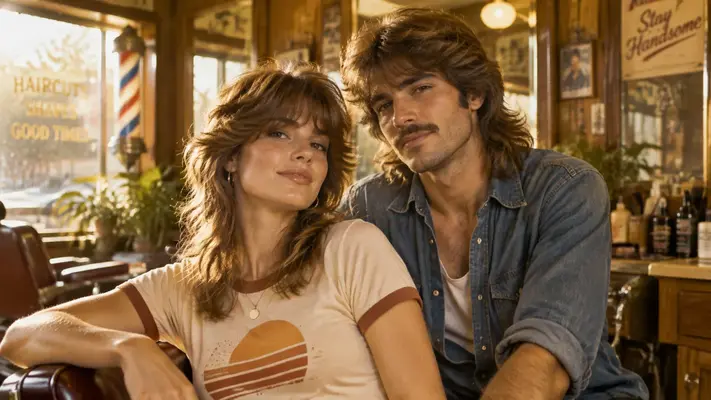
Your barber probably winced the last time you said “short in front, long in back.” Now he asks for a photo first.
The 70s mullet went from glam-rock rebellion to punchline to full comeback, and it has never looked better. This guide shows you how to ask for it, style it, and dodge the mistakes that made 1988 so memorable.
You’ll get seven styles, face-shape matching, a daily routine, and straight answers to the questions people type into Google. Read the barber script before you book.
Where the 70s Mullet Really Started
Most people blame the 1980s. The truth runs older. The silhouette took shape in the early 1970s, when glam rock scrambled every rule about gender and hair.
David Bowie’s 1972 Ziggy Stardust cut, short on top with longer, choppy sections behind, lit the fuse. Rod Stewart’s shaggy, layered rock look kept it burning. Musicians and footballers copied the shape within months.
Meanwhile, the shag haircut arrived with heavy layers and feathered edges. Blend the two and you get the direct ancestor of today’s cut. Flip through mullet 70s photos and you’ll spot that mix everywhere: volume on top, wispy length behind, nothing too tidy.
A Quick Timeline
| Year | Moment | Why It Mattered |
| 1971 | Jane Fonda’s shag in Klute | Made cropped, layered hair look tough and glamorous |
| 1972 | Bowie’s Ziggy Stardust | Turned the short-top, long-back shape into a statement |
| Mid-1970s | Shag cuts go mainstream | Salons everywhere sold feathered layers |
| Early 1980s | Blunt, longer tails appear | The soft look hardened into the caricature we joke about |
Notice the pattern. The cut started soft and artistic, then got flattened into a cliché once everyone copied it without the layering. That gap explains why the modern version works: stylists have gone back to the original blending.
The 70s Shag Mullet Blueprint
The classic recipe is simple. Every element looks deliberately messy, which is exactly why it’s hard to fake.
- Heavy layering through the crown for lift and movement
- Feathered edges that blur the line between top and back
- A face-framing fringe, cut long and swept to the side
- Nape length that touches or passes the collar
- Soft texture instead of sharp, geometric lines
Ask your stylist for point-cutting or razor work at the ends. Blunt scissors create that hard shelf everyone fears. Point-cutting creates the airy, broken-up finish that defines the original.
Then vs. Now: What Changed by the 1980s
| Feature | 1970s Version | 1980s Version |
| Layers | Soft and feathered | Blunt and stacked |
| Top | Voluminous, natural | Teased and sprayed |
| Back | Wispy, collar length | Long, often straight |
| Sides | Blended, covering the ears | Cropped short |
| Attitude | Rebellious, artistic | Loud, mainstream |
The 1970s version wins on wearability. It moves, frames the face, and forgives a missed trim. The 1980s version demanded hairspray and total commitment.
70s Mullet Women: Soft, Layered, and Fearless
Women shaped the era’s shaggy look as much as any rock star did. Fonda’s Klute haircut proved that a layered crop could carry attitude without losing softness.
Today’s version leans gentler than the originals. Stylists blend the layers so nothing reads as a hard shelf, and the result looks lived-in rather than costume-like.
Best Cuts for Women
- Curtain-fringe shag: Face-framing bangs plus choppy layers. Great for straight or wavy hair.
- Wispy mini mullet: A short back section, barely past the ears. Ideal if you’re nervous about length.
- Curly mullet: Layers follow your natural curl pattern. Ask for a dry cut so the stylist sees the true shape.
The 70s Mullet Woman Look: Who Wears It Best
Anyone with medium-to-thick hair has an easy start. Fine hair works too, but request internal layers to fake density.
Wavy texture gives the most authentic retro result with the least effort. Straight hair needs a bit more product, usually a sea-salt spray and a diffuser or round-brush blow-dry.
70s Mullet Man: Rock-and-Roll Edges
Men’s versions lean shaggier and looser. Think tousled top, side-swept fringe, and length that grazes the shoulders. Sideburns stay full, and a light moustache is optional.
A modern 70s mullet man look softens the contrast between top and back. Barbers now graduate the sides instead of shaving them close, so the cut reads as intentional rather than accidental.
Thick or wavy hair suits this style best. Straight, fine hair needs texturizing spray and a blow-dry to hold the shape. Beard shape matters too: a slightly scruffy beard balances the volume, while a razor-sharp beard fights it.
7 Ways to Wear It Today
Each of these takes the 70s mullet in a slightly different direction. Pick the one that matches your patience and your job.
1. Classic Shag Mullet
Full layers, feathered fringe, collar-length back. Best for thick, wavy hair and people who enjoy styling.
2. Soft Mullet
Blended sides with subtle length behind. Best for first-timers who want the shape without the shock.
3. Curly Mullet
Bouncy top with natural curls at the nape. Best for coils and tight waves, since the curl does the work.
4. Wolf-Cut Hybrid
Extra volume and choppy ends. Best for round or square faces that need softness.
5. Mini Mullet
A barely-there tail. Best for conservative offices and anyone easing in.
6. Bleached Mullet
Platinum, copper, or honey tones for festival energy. Best for confident dressers, though bleach demands a strict conditioning routine.
7. Sleek Undercut Mullet
Straight hair, clean sides, dramatic back. Best for people who want edge with minimal daily effort.
Match the Cut to Your Face Shape
| Face Shape | Best Variation | Pro Tip |
| Oval | Classic shag | Almost anything works |
| Round | Longer layers, side-swept fringe | Add height at the crown |
| Square | Soft mullet, curtain fringe | Blur the jawline with wisps |
| Heart | Wolf-cut hybrid | Keep the fringe light |
| Long | Curly or mini mullet | Skip extra length at the back |
Use this table as a starting point, not a rulebook. Hair density, growth patterns, and cowlicks change the outcome more than face shape does, so let your stylist adjust on the day.
Your Daily Styling Routine
- Towel-dry gently, then apply a light mousse or sea-salt spray.
- Blow-dry the crown upward with your fingers to build lift.
- Rough-dry the back, keeping the ends loose.
- Twist small sections of the fringe around your finger for a feathered flick.
- Finish with texture paste or a flexible-hold cream.
- Skip the hairspray. Movement is the whole point.
Trim every six to eight weeks. The shape collapses fast once the layers grow out. Between cuts, use a leave-in conditioner on the tail, since the longest hair is also the oldest and driest.
Barber Script and Mistakes to Avoid
Bring two photos and say: “Longer layers through the back, soft blending on the sides, and a fringe that frames my face.” Photos beat adjectives every time.
Avoid these traps:
- Shaving the sides too short, which creates a harsh 1980s line
- Cutting the fringe blunt instead of feathered
- Over-styling with heavy gel
- Skipping regular trims
- Letting the tail grow past the shoulder blades without shaping it
Frequently Asked Questions
What is a 70s shag mullet?
It’s a layered cut with shaggy, feathered texture, more volume on top, and extra length at the back. The blending is soft, which separates it from the harsher 1980s version.
Does a 70s mullet work on thin hair?
Yes. Ask for internal layers and a lightweight texture spray. Keep the fringe wispy and avoid heavy products that flatten the crown.
How long does my hair need to be?
Aim for at least four inches on top and three inches at the nape. Anything shorter limits how much layering your stylist can build.
How often should I trim it?
Every six to eight weeks. Layers lose their shape quickly, and the back can look stringy without regular maintenance.
Is the 70s mullet still in style in 2026?
Yes. Runways, festivals, and street style keep pushing it, especially in softer, blended versions that look modern rather than nostalgic.
Can I wear it to work?
Yes, choose the mini or soft version. Keep the back tidy and the fringe polished, and most offices won’t blink.
Conclusion
If you love texture, movement, and a little swagger, the 70s mullet is worth the appointment. It rewards confidence more than perfection.
Insider tip: start with the soft version. You can always add length and drama later, but you can’t glue hair back on.