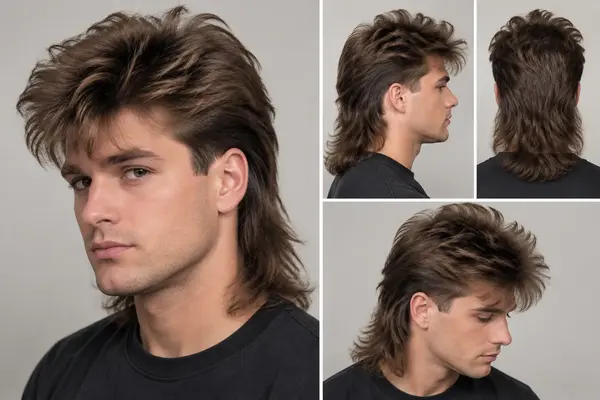
Nobody expected the 90s mullet to come roaring back into barbershops and salons decades later, yet here we are. Business up front, party in the back walked so today’s shag-mullet hybrids could run.
This isn’t just about the 90s mullet haircut itself. It’s about what that haircut represented — a decade that stopped asking for permission and started making bold, loud choices with everything from music to fashion.
If you’ve ever wondered why this one style sparked so much love, mockery, and copycat energy, you’re about to get the full story, including regional versions most people never even knew existed.
A Quick Look Back: How the Look Actually Started
Long-back, short-front hairstyles existed in some form for centuries, worn by everyone from ancient warriors to 1970s rock stars. But the specific silhouette people picture today didn’t fully click into place until MTV, satellite television, and touring musicians gave it a consistent visual identity.
Small-town barbershops played a bigger role than most people realize. A single popular client — a football coach, a local musician, a radio DJ — could influence dozens of copycat cuts within a single town simply by walking around with the look every week.
Magazines and album covers then carried that regional trend national, and eventually international, turning a barbershop choice into a defining symbol of an entire decade.
Why the Mullet 90s Era Became Unstoppable
The mullet 90s wave spread because it solved a real problem: people wanted hair that looked good on camera but still stayed practical for everyday work, sports, and outdoor life.
Barbers noticed something important too. The cut was forgiving. Thick hair, thin hair, curly hair, straight hair — nearly anyone could adapt some version of it, which helped it cross into nearly every subculture imaginable.
There was also a psychological pull. Wearing it signaled that you weren’t playing by traditional grooming rules, and during a decade obsessed with rebellion, flannel, and garage bands, that message resonated deeply with young people everywhere.
90s Mullet Men vs 90s Mullet Women: Two Very Different Vibes
90s Mullet Men: Bold and Business-Free
90s mullet men leaned hard into rugged simplicity. Sides stayed short and clean, often just above the ears, while the back grew out to brush the collar or even the shoulders on more dedicated wearers.
Athletes especially favored this version. It kept hair out of their eyes during games while still looking effortlessly cool the moment they left the field or rink.
Working-class men also embraced it heavily because it required almost no daily maintenance. A quick comb and you were done, which mattered a lot in an era before elaborate styling products became mainstream.
90s Mullet Woman Energy on Every Screen
The version a 90s mullet woman wore often looked softer around the face. Choppy bangs, feathered layers, and face-framing pieces turned it into something closer to editorial fashion than a backyard trend.
A single appearance on television could influence salon requests across an entire region within weeks. Stylists reported clients bringing in magazine clippings just to replicate one specific celebrity’s exact shape and length.
This version proved the style wasn’t tied to any one gender. It simply adapted based on face shape, hair texture, and how bold someone wanted to look that season.
Mullet Haircut 90s Icons: From Country Charts to Rock Arenas
Billy Ray Cyrus 90s Mullet: The Achy Breaky Legend
No conversation about mullet haircut 90s history is complete without the man who arguably made it mainstream worldwide. The billy ray cyrus 90s mullet became so recognizable it practically functioned as a second album cover.
That single look, paired with “Achy Breaky Heart,” pushed country fashion into mainstream pop culture in a way very few hairstyles ever manage to achieve, even decades later.
Fans across continents who had never even visited Nashville still recognized that exact silhouette instantly, which shows how powerful television exposure was during that period.
90s Country Mullet and Its Nashville Roots
Beyond Cyrus, the 90s country mullet thrived on stages across Nashville and touring circuits nationwide. Fringed jackets, cowboy boots, and that signature back-length hair became a complete package for performers.
Several other 90s country singer mullet looks followed a similar formula: neat and controlled on top, dramatic and flowing in the back, always ready for stage lighting and close-up camera shots.
Local country bands in small towns copied this template too, understanding that the right haircut could make even a modest stage setup feel like a real concert.
90s Rock Mullet: Headbanger Energy
Over on the rock side, the 90s rock mullet got messier, spikier, and far less concerned with symmetry. Guitarists and drummers wore theirs long and heavily layered so it whipped dramatically during live performances.
This version leaned into controlled chaos on purpose. It paired perfectly with leather jackets, distorted amplifiers, and the general anti-polish attitude that defined most rock scenes at the time.
Curly Mullet 90s: Texture Made the Difference
A curly mullet 90s style added natural volume that straight-haired versions simply couldn’t replicate. The curls at the back created a built-in mane effect that felt theatrical without requiring extra styling effort.
For people with tighter coils, the 90s mullet curly approach became a favorite because it worked with their natural texture instead of fighting against it constantly with heat tools.
Stylists during this era often recommended simple finger-coiling and lightweight curl creams rather than heavy gels, letting the natural pattern do most of the visual work on its own.
90s Mexican Mullet Culture and Its Own Distinct Flavor
The 90s mexican mullet developed a genuinely distinct regional identity, especially across working-class neighborhoods where the cut symbolized toughness, pride, and personal style. It often paired with slicked-back sides and a slightly longer, wavier tail.
Barbershops specializing in mexican mullet 90s styling became neighborhood institutions in many cities, passing exact techniques down through generations of barbers who understood precisely how much length and taper the community preferred.
This version often blended influences from lowrider culture and regional music scenes, giving it a flavor that felt completely different from the country or rock interpretations happening elsewhere at the same time.
90s Modern Mullet: Bringing the Classic Into Today
Stylists today have reworked the concept into a 90s modern mullet, often blending it with skin fades, textured crops, or soft waves. It keeps the rebellious spirit while feeling far more wearable for office jobs and daily professional life.
This updated version proves the original idea was never really about raw hair length. It was always about contrast — short versus long, structured versus wild — and that contrast still reads as stylish today.
Barbers now use texturizing scissors and point-cutting techniques that simply didn’t exist in most small-town shops back in the original era, giving the modern version a noticeably cleaner finish.
90s Short Mullet and 90s Mullet Wig Options
Not every version went dramatic. The 90s short mullet trimmed the back significantly, offering a subtler nod to the trend for people who wanted the vibe without full commitment or workplace pushback.
For costume parties, throwbacks, or themed photoshoots, a 90s mullet wig remains one of the easiest ways to nail the aesthetic instantly, no scissors required and zero regret if you change your mind the next morning.
Quality wigs today come pre-styled with realistic layering, meaning even a last-minute costume choice can look convincingly authentic under normal party lighting.
Style Comparison at a Glance
| Style Variation | Best For | Vibe |
| 90s Mullet Men | Low-maintenance daily wear | Rugged, simple |
| 90s Mullet Woman | Fashion-forward statements | Editorial, bold |
| Curly Mullet 90s | Natural curl texture | Voluminous, playful |
| 90s Country Mullet | Western-inspired looks | Nostalgic, charming |
| 90s Rock Mullet | Stage performances | Wild, dramatic |
| 90s Short Mullet | Subtle throwback | Understated, wearable |
This table shows just how flexible one haircut concept became. Instead of a single rigid style, it split into distinct lanes that fit almost any personality, profession, or occasion someone might need it for.
Frequently Asked Questions
What decade made the mullet famous?
The style existed earlier in various forms, but it exploded in popularity during the 1990s thanks to music television, touring musicians, and mainstream celebrities embracing the look on camera constantly.
Is the mullet coming back in style?
Yes, modern barbers regularly blend the classic silhouette with fades and textured layers, giving it a fresh, wearable update that fits comfortably into today’s fashion scene.
Does the mullet work with curly hair?
Absolutely. Curly textures often enhance the back volume naturally, creating a fuller, more dramatic shape without requiring much extra daily styling work.
Who is most associated with this haircut in the 90s?
Billy Ray Cyrus remains one of the most recognizable faces tied to the look, largely thanks to his massive country music fame throughout that era.
Can women pull off this haircut too?
Definitely. Many women embraced softer, layered versions with face-framing pieces, proving the style was never limited to any one gender or age group.
Are wigs a good alternative to cutting your hair?
Wigs are a great low-commitment option, especially for costume events or temporary style experiments before someone decides on anything permanent.
Which regions had their own unique take on the style?
Several communities, including Mexican American neighborhoods, developed distinct regional versions with their own preferred lengths, tapers, and finishing techniques passed down locally.
Conclusion
This haircut earned its legendary status because it refused to follow a single script. Every region, genre, and personality bent it into something new, and that flexibility is exactly why it still shows up in barbershops today.
If you’re thinking about trying a version yourself, start subtle, watch how it grows out over a few weeks, and let your natural texture guide the final shape rather than forcing a look that doesn’t fit your hair type.