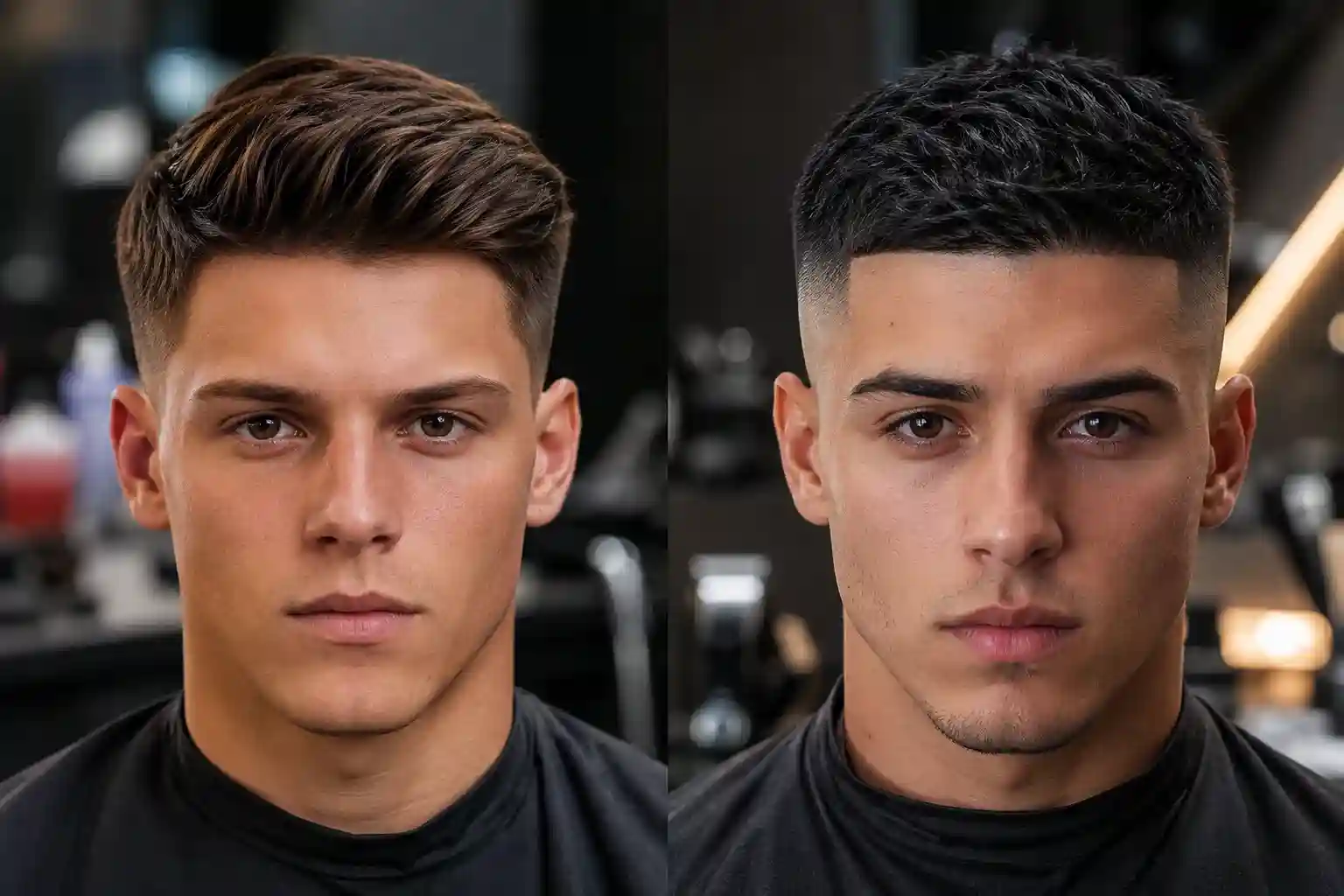
Standing in the barber’s chair, you hear the question: “Taper or fade?” You freeze. Both sound similar, but picking wrong means weeks of regret staring back from the mirror. This guide breaks down the taper vs fade haircut debate in plain English, so you walk in confident and walk out with a cut you actually love.
What Is a Taper Haircut?
A taper haircut keeps hair longest at the top of the head and gradually shortens it on the way down to the neckline and around the ears. The change happens slowly, with no harsh lines or sudden drop in length.
Barbers use clippers with graduated guard sizes to blend one length into the next. The result looks neat, controlled, and works well for almost any hair type or profession.
Most classic men’s haircuts already include some form of taper. A crew cut, a side part, and a pompadour all rely on tapering to keep the sides from looking bulky.
What Is a Fade Haircut?
A fade haircut also shortens hair as it moves down the head, but it does so faster and more dramatically. Instead of a gentle slope, hair disappears into the skin, creating a bald or near-bald strip near the hairline.
This sharp contrast between long hair on top and bare skin below is what gives a fade its bold, modern edge. Barbers often finish a fade with a straight razor or foil shaver for a crisp, skin-level result.
Fades come in different heights, and where the fade starts changes the entire look of the cut.
Taper vs Fade Haircut: The Core Differences Explained
The taper vs fade haircut choice really comes down to three things: speed of transition, final length, and overall attitude of the style.
- Transition speed: A taper fades slowly; a fade drops quickly.
- Final length: A taper rarely reaches bare skin; a fade often does.
- Overall vibe: A taper reads polished and safe; a fade reads bold and current.
Think of a taper as a smooth hill and a fade as a cliff edge. Both take you from high ground to low ground, but the journey feels completely different. This single image solves most of the confusion around the taper vs fade haircut question.
Taper vs Fade Haircut Comparison Table
Here is a side-by-side breakdown to settle the taper vs fade haircut debate at a glance.
| Feature | Taper Haircut | Fade Haircut |
| Length at the bottom | Short, but not bare skin | Often cut down to skin |
| Transition style | Gradual and smooth | Sharp and high-contrast |
| Tools used | Clippers with guards | Clippers, then razor or foil shaver |
| Maintenance frequency | Every 4 to 6 weeks | Every 2 to 3 weeks |
| Formality level | Conservative, office-friendly | Fashion-forward, casual |
| Best face shapes | Oval, square, long | Round, heart-shaped |
| Best hair types | Fine, thin, wavy | Thick, curly, coily |
| Average cost | Standard haircut price | Often $5 to $15 more |
| Regrowth appearance | Grows out cleanly | Shows roots and unevenness faster |
| Popular pairings | Side part, comb-over, quiff | Pompadour, textured crop, mohawk |
Types of Taper Haircuts You Can Ask For
Not every taper looks the same. Knowing the names helps you describe exactly what you want.
- Low taper: Length reduction stays close to the hairline, very subtle.
- Mid taper: Blending starts around ear level for a balanced look.
- High taper: Shortening begins higher up, giving more shape without going full fade.
- Temple taper: Focuses only on the sides near the temples, leaving the back longer.
Each version of a taper haircut suits a different comfort level with change, so you can start conservative and go bolder over time.
Types of Fade Haircuts You Can Ask For
Fades also come in several heights and finishes, each changing how dramatic the final look feels.
- Low fade: Starts just above the ear, subtle and beginner-friendly.
- Mid fade: Begins around the temple, a common everyday choice.
- High fade: Starts near the top of the head for maximum contrast.
- Skin fade: Cut all the way down to bare skin for the sharpest finish.
- Drop fade: Follows the natural curve of the head, curving behind the ear.
When people compare a taper vs fade haircut, the skin fade and high fade are usually what they picture as the “fade” side of the argument.
Taper vs Fade: Which Suits Your Face Shape?
Your face shape plays a bigger role in this decision than most people realize.
- Round faces: A fade adds angles and sharp lines, breaking up roundness.
- Square faces: A taper softens strong jawlines without hiding them.
- Oval faces: Both cuts work well since oval faces suit most hairstyles.
- Long faces: A taper avoids adding extra height, keeping proportions balanced.
- Heart-shaped faces: A fade with volume on top balances a narrower chin.
If you are still unsure, bring a mirror selfie to your consultation and ask your barber directly which side of the taper vs fade haircut spectrum fits your bone structure.
Taper vs Fade: Which Suits Your Hair Type?
The cleanliness of each cut varies depending on the structure of the hair in between treatments.
Fine or thin hair often looks better with a taper, since a fade can expose patchy scalp and make hair look sparser than it is. Thick, curly, or coily hair holds sharp fade lines beautifully and grows back with enough density to avoid a patchy look.
Wavy hair sits somewhere in the middle and usually works with a soft taper or a low fade, depending on how much contrast you want.
Taper vs Fade Haircut: Maintenance and Regrowth Compared
Upkeep is where the taper vs fade haircut decision really separates the two styles.
A taper grows out gradually and still looks intentional after four to six weeks. A fade, especially a skin fade, starts looking rough within two to three weeks as regrowth blurs that sharp line near the skin.
- Tapers: fewer barber visits, lower long-term cost.
- Fades: sharper look, but demands regular upkeep to stay clean.
If your schedule or budget makes frequent barber visits difficult, a taper is the more forgiving option.
Taper vs Fade Haircut: Which One Fits Your Lifestyle?
Your daily routine matters as much as your hair type.
Corporate offices, client-facing roles, and conservative industries usually favor a taper haircut. It reads professional without looking dated. Creative fields, fashion-forward workplaces, and casual environments tend to embrace fades, since the style signals confidence and current trends.
Neither choice is objectively better. The right side of the taper vs fade haircut comparison depends entirely on where you spend most of your time and what impression you want to give.
Taper Fade Haircut: When You Want Both Styles Combined
A taper fade blends both techniques into one cut. The top stays longer like a taper, while the sides fade down more aggressively like a fade. This combination gives you a polished top with an edgy finish underneath.
Most barbers now use “taper fade” as a catch-all request, so if you say either term, expect your barber to ask follow-up questions about how short and how high you want the sides.
How to Ask Your Barber for a Taper or a Fade
Clear communication prevents an unwanted trip back to the chair for fixes.
- Bring one or two reference photos, not ten.
- Describe the finish, not just the name (skin, blended, or slightly grown out).
- Point to where you want the shortening to start on your head.
- Mention your hair type and how often you can return for maintenance.
- Ask your barber which option, taper or fade, fits your face shape.
A five-minute conversation before the clippers start saves weeks of awkward regrowth.
Common Mistakes to Avoid When Choosing Between Taper and Fade
- Assuming both terms mean the same thing and getting a surprise result.
- Picking a skin fade without a maintenance plan for the regrowth period.
- Ignoring your natural hair texture when chasing a trending style online.
- Choosing a bold fade right before a formal event with no time to adjust.
- Forgetting to mention your face shape or lifestyle during the consultation.
Avoiding these mistakes turns the taper vs fade haircut decision from a guessing game into a confident choice.
Cost Comparison: Taper vs Fade Haircut
Pricing varies by city and barbershop, but general patterns hold true across most markets.
A standard taper usually falls within a shop’s base haircut price since it uses only clippers and guards. A fade, particularly a skin fade finished with a razor, often costs five to fifteen dollars more because of the extra time and precision involved.
Factor in visit frequency too. A fade’s shorter maintenance window means the real cost difference adds up over a full year, not just per visit.
Conclusion
There is no universal winner in the taper vs fade haircut debate. A taper offers a safe, low-maintenance, professional look that suits almost any hair type and face shape. A fade delivers a bold, high-contrast style for anyone willing to keep up with regular touch-ups.
Match the cut to your face shape, hair texture, lifestyle, and how often you can realistically see your barber. Get that combination right, and either style will look sharp for weeks.
Frequently Asked Questions
Is a taper the same as a fade? No. A taper changes hair length gradually and rarely reaches bare skin, while a fade shortens hair quickly and often blends down to the skin for a sharper contrast.
Which is better, taper or fade? Neither is universally better. A taper suits professional settings and lower maintenance schedules, while a fade suits bold styles and hair types that hold sharp lines well.
Does a taper fade cost more than a regular fade?
A taper fade usually costs about the same as a standard fade, since both require similar clipper and razor work along the sides and back.
Can I get a taper if I have curly hair?
Yes. Curly hair works well with a taper, and the gradual blend actually helps control volume better than an aggressive fade in many cases.
How often should I get a taper vs fade touched up?
Plan on four to six weeks for a taper and two to three weeks for a fade, since fades lose their sharp line much faster as hair regrows.
Can a taper turn into a fade later?
Yes. Many people start with a low taper and gradually ask their barber to raise and sharpen the line over a few visits until it becomes a full fade.