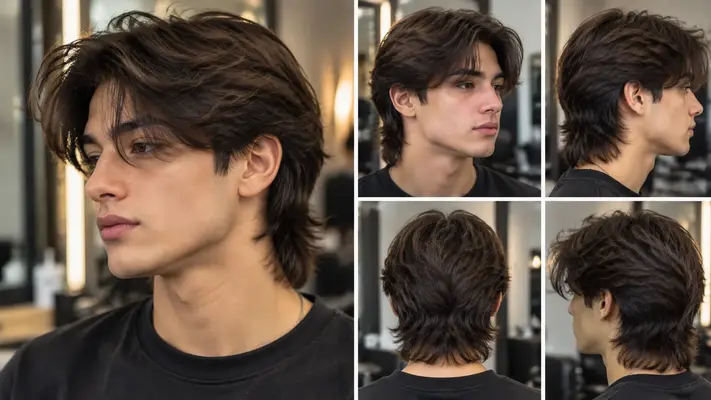
You’ve seen it on your feed a dozen times this week and you still can’t name it. That shaggy, effortless cut with the longer back and the messy top? It’s the soft mullet, and it’s about to be the easiest way to look like you tried without actually trying.
This guide breaks down every version of the cut, who it flatters, and exactly what to say to your barber so you don’t walk out looking like a 1985 rock poster.
What Makes A Mullet “Soft” Anyway?
The old mullet had a hard line. Short on top, long in the back, and a sharp shelf where the two lengths met. Nobody blended anything on purpose.
A soft version fixes that. The stylist blends the lengths with texturizing shears so the top melts into the back instead of stopping abruptly. There’s no visible line, just a gradual shift.
That single change is why the style reads as modern instead of retro. It’s the difference between a costume and an actual haircut you’d wear to work.
The Blend Is Everything
- Layers are cut at varying lengths, not one blunt line
- The nape stays soft and feathered, never squared off
- Texture is added throughout, not just at the ends
- Product is worked in for movement, not slicked down
Soft Mullet Men Are Actually Requesting Right Now
Barbers report this as one of their most requested cuts among men under 35. It works because it’s low-maintenance on busy mornings but still has personality.
A mens soft mullet usually pairs shorter sides with length left generously on top and back. The sides don’t need to be shaved; a soft taper works just as well and ages better between appointments.
Popular Men’s Variations
| Style | Sides | Top Length | Best For |
| Soft mullet fade | Faded, tight | Medium-long | Straight or wavy hair |
| Soft mullet taper | Gradual taper | Medium | Office-friendly settings |
| Baby mullet and soft mullet | Very short | Short-medium | First-timers testing the look |
| Curly soft mullet | Natural, untouched | Long, voluminous | Curly or coily textures |
A quick read of the table above shows the real trend: nobody’s going extreme anymore. Every version keeps enough length to look intentional without demanding a shave every ten days.
Soft Mullet Wolf Cut: The Style Everyone’s Searching For
Search interest around the wolf cut hybrid has climbed steadily since 2023, and it hasn’t slowed down. This version borrows heavy layering from the wolf cut and blends it into mullet shape.
The result has serious volume on top, choppy face-framing pieces, and a back that flows instead of hanging flat. It’s less about a clean silhouette and more about controlled chaos.
Who Should Try It
- People with naturally thick or wavy hair that holds shape
- Anyone bored of one-length lobs or bobs
- Those who want a low-effort styling routine with high visual payoff
A soft mullet wolf cut female client often asks for extra face-framing layers up front, while keeping the crown heavier for volume. That combination is what separates it from a plain shag.
Soft Mullet Women Are Choosing Over Classic Layers
Women’s versions have moved away from anything dramatic. A soft mullet woman today usually keeps the front pieces long enough to tuck behind an ear, with shorter, choppier layers building height at the crown.
This softened approach flatters more face shapes than the exaggerated 90s version ever did. Round faces get lift at the crown, while longer faces benefit from the width the layers create around the cheeks.
Styling Tips for Women
- Rough-dry with a diffuser to encourage natural texture
- Apply a light texturizing spray before blow-drying, not after
- Use a small round brush only at the crown for lift
- Leave the ends alone; too much smoothing kills the shape
Soft Modern Mullet Cuts By Hair Type
Not every texture handles this shape the same way, which is exactly why barbers customize it so heavily. Here’s how three common textures translate.
Curly Hair
A soft mullet curly hair cut relies on the natural spring of the curl to create separation. Barbers cut it slightly longer than they would on straight hair because curls shrink up once they dry.
Straight Hair
Straight textures need more deliberate layering since there’s no natural volume to fall back on. A texturizing spray and some backcombing at the crown usually finish the look.
Asian Hair Textures
An asian soft mullet often works with thicker, straighter strands by adding heavier internal layers. This prevents the classic “helmet” effect that thick straight hair can create without proper thinning.
How To Ask Your Barber For It (Word For Word)
Walking in with a vague idea is how people end up with a haircut they didn’t want. Bring a photo, but also use this language to be specific.
- “I want a soft mullet haircut, not a hard-line 80s version”
- “Blend the top into the back with no visible shelf”
- “Keep [X inches] in the back, texturize the crown”
- “Taper the sides instead of shaving them completely”
Being this specific matters more than people expect. A soft mullet male client and a soft mullet female client are asking for the same blending technique, just with different length ratios.
Maintenance: What Nobody Tells You Upfront
This cut looks low-maintenance, and it mostly is, but it does need a plan. Growing out layers unevenly is the fastest way to lose the shape entirely.
| Maintenance Task | Frequency | Why It Matters |
| Trim | Every 6-8 weeks | Keeps layers from growing shapeless |
| Deep condition | Weekly | Longer back sections dry out faster |
| Texturizing product | Daily styling | Maintains separation between layers |
| Neck cleanup | Every 2-3 weeks | Prevents the “grown out” look at the nape |
Skipping trims for more than eight weeks is where most people go wrong. The layers that gave the cut its shape start blending into one length, and suddenly it just looks like long hair with no plan.
Frequently Asked Questions
Is a soft mullet still in style in 2026?
Yes, and search data along with barber demand both back that up. It’s one of the more requested shag-adjacent cuts this year because it works on more hair types than the original 80s version.
Does a soft mullet work on fine hair?
It can, but the stylist needs to avoid removing too much weight. Fine hair benefits from lighter layering and a shorter overall length so it doesn’t fall flat by midday.
How long does hair need to be to start one?
Most barbers want at least three to four inches in the back to create visible length contrast. Shorter than that and the cut reads more like a textured crop than an actual mullet shape.
Can I go from a regular haircut straight into this style?
Usually yes, in one appointment, since the technique is about blending rather than growing anything out first. The exception is if your current cut has almost no length in the back to work with.
What’s the difference between this and a wolf cut?
A wolf cut is heavier on shaggy, choppy layering throughout, while this style keeps a clearer length distinction between the top and back. The hybrid version borrows from both.
Is it hard to style at home?
Not really. A texturizing spray, a rough blow-dry with your fingers, and occasional use of a small round brush at the crown covers most days without needing a curling iron or straightener.
Will it suit a round face?
Generally yes, especially with extra height built into the crown and some length left around the jawline to create a longer visual line down the face.
Conclusion
If you want one haircut that photographs well, grows out gracefully, and doesn’t chain you to a barber’s chair every three weeks, this is it. The blend is the entire point, so don’t let anyone talk you into a hard line “for authenticity.”
Bring a clear photo, use the exact phrasing from this guide, and trust the process through one slightly awkward growing-in phase. That’s the only real price of admission.