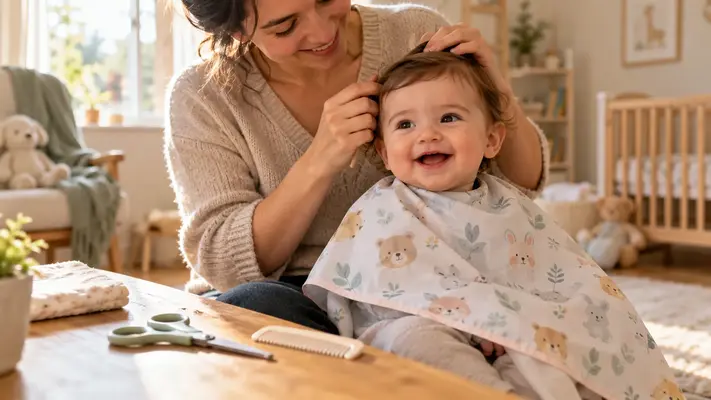
One minute your baby has no hair at all. The next, it’s curling over their ears and creeping into their eyes, and you’re wondering if this is finally the moment for a newborn first haircut.
This guide walks through every part of that decision, from timing and tools to cultural traditions, mistakes to avoid, and exactly how to keep your baby calm through the whole thing.
Why the Newborn First Haircut Feels Like Such a Big Deal
Parents often admit this milestone catches them off guard emotionally. It’s not just hair falling to the floor, it’s a visible sign that your baby is growing up fast.
Some cultures treat this moment as a formal ritual with religious meaning. Others treat it as a purely practical grooming task with zero fuss attached.
The Emotional Side Parents Rarely Talk About
- A sense of losing the “newborn” phase permanently
- Nostalgia tied to how the hair looked at birth
- Pressure to capture the perfect photo or keepsake
- Anxiety about causing pain or fear in the baby
The Practical Side That Actually Matters More
- Hair blocking vision and causing constant rubbing of the eyes
- Tangles forming faster than a brush can manage
- Uneven growth patterns from lying on the back often
- Heat discomfort in warmer climates from thick, longer hair
When Should You Actually Schedule a Newborn First Haircut?
There’s no single official age recommended by pediatric associations. Timing depends entirely on hair growth speed, which varies wildly between babies.
Most families end up trimming somewhere between 6 and 12 months, but plenty of babies need it earlier or don’t need it until 18 months.
Age-Based Readiness Breakdown
| Age Range | Typical Hair Situation | Haircut Recommended? |
| 0–3 months | Very fine, patchy, often falls out naturally | Rarely needed |
| 4–6 months | Regrowth begins, texture changes | Sometimes, if in eyes |
| 6–9 months | Noticeable length, uneven ends | Common window |
| 9–12 months | Thicker, more manageable | Very common window |
| 12+ months | Full head of hair, styling possible | Often first “real” cut |
The data shows a clear pattern. As hair thickens and becomes easier to handle safely, more parents feel confident moving forward with that first trim.
Signs Your Baby Is Truly Ready
- They tug at their own hair out of visible irritation
- Hair covers the eyebrows or eyelashes consistently
- The neckline area looks patchy from friction while sleeping
- Your baby can stay reasonably still for two to three minutes
Signs It’s Better to Wait
- Hair is still too fine and sparse to trim evenly
- Baby has a strong startle reflex around new sounds or tools
- There’s no functional need, only a desire to “style” early
- Baby is going through a clingy or fussy developmental phase
Complete Tool Checklist for a Safe Newborn First Haircut
Home haircuts go wrong far more often because of bad tools than bad technique. Investing in the right basics changes everything.
Essential Tools List
- Rounded-tip stainless steel baby scissors
- Quiet-motor baby hair clipper designed for infants
- Wide-tooth comb made from soft, flexible material
- A soft cape, bib, or old t-shirt to catch clippings
- A small spray bottle with water to dampen stubborn strands
- Distraction items: musical toy, mirror, or a favorite snack
- A well-lit, quiet space free from siblings or pets
Tools You Should Avoid Completely
- Adult-sized scissors with sharp pointed tips
- Loud, vibrating adult clippers not designed for infants
- Metal combs that can scratch a sensitive scalp
- Any tool borrowed from a pet grooming kit
Quiet clippers matter more than most parents expect. A sudden loud buzz near a baby’s ear is often the exact reason a haircut turns into a crying session.
Step-by-Step Process for a Stress-Free Newborn First Haircut
Skipping steps is where most parents run into trouble. Following this order keeps both baby and parent calm from start to finish.
Step 1: Choose the Right Time of Day
Pick a moment right after a nap and a meal, when your baby is naturally content. Avoid attempting this during teething flare-ups or growth spurt fussiness.
Step 2: Prepare the Environment First
Set up everything within arm’s reach before starting, including tools, a towel, and a distraction toy. Running to grab something mid-cut breaks concentration and startles the baby.
Step 3: Do a “Dry Run” First
Turn on the clippers without touching the baby, letting them hear the sound from a distance. This single step prevents most fear-based reactions during the actual cut.
Step 4: Work in Small, Controlled Sections
Divide the head into sections and trim only the very tips of each one. Rushing through large chunks increases the risk of uneven cuts and accidental nicks.
Step 5: Take Breaks Whenever Needed
Stop every few minutes for praise, a snack, or simply a cuddle. A haircut spread across three short sessions beats one long, stressful sitting every time.
Step 6: Clean Up Immediately
Loose hair can be itchy and uncomfortable against sensitive skin. Wipe down the neck and shoulders gently with a damp cloth right after finishing.
Cultural Traditions Around a Baby’s First Haircut
Many cultures treat this event as far more than routine grooming. Understanding these traditions adds meaning for families who want to honor them.
Common Traditions Around the World
- Mundan ceremony (South Asian tradition): The head is fully shaved, often at a temple, symbolizing removal of past-life negativity.
- Aqiqah tradition (Islamic practice): Hair is shaved and weighed, with the equivalent value in silver donated to charity.
- First-year cut (East Asian customs): Some families wait until the first birthday specifically, tying it to a broader celebration.
- Western keepsake trend: Many parents simply save a lock of hair in a baby book without any religious significance attached.
None of these traditions are required, and plenty of families skip ceremony entirely in favor of a quiet trim at the kitchen table.
Newborn First Haircut: DIY at Home vs. Professional Baby Salon
This decision usually comes down to comfort level rather than any strict right answer. Both options are completely valid depending on your baby’s temperament.
Comparison Table
| Factor | DIY at Home | Baby Salon |
| Cost | Free to low cost | 20–50 on average |
| Comfort for baby | Familiar environment | New, sometimes overwhelming |
| Tool quality | Depends on what you buy | Professional-grade |
| Keepsake options | Manual, DIY effort | Often included automatically |
| Risk of uneven cut | Higher for beginners | Lower, trained stylists |
| Convenience | Anytime, no appointment | Requires scheduling |
When DIY Makes More Sense
- Your baby gets anxious in unfamiliar environments
- You only need a small trim, not a full style
- Budget is a bigger priority than convenience
When a Salon Makes More Sense
- Your baby has particularly thick or curly hair
- You want a professional-looking result for photos
- You’d prefer someone experienced handling a squirmy baby
Common Mistakes Parents Make During a Newborn First Haircut
Even careful parents fall into predictable traps here. Knowing them ahead of time saves real frustration later.
- Attempting the cut when the baby is overtired or hungry
- Using household scissors instead of rounded safety scissors
- Cutting too much at once out of nervous overcorrection
- Skipping the dry-run step with clippers turned off
- Forcing the process through tears instead of pausing
- Ignoring the neckline area, leaving it patchy and uneven
- Not preparing a distraction toy or snack in advance
Aftercare Tips Once the Haircut Is Done
The process doesn’t end the moment the scissors go down. A few small aftercare steps keep skin comfortable and hair looking neat.
- Gently brush away any remaining loose hairs from clothing
- Give a light bath if hair got into sensitive areas like the ears
- Check behind the ears and neck for stray clippings
- Praise your baby warmly to build positive associations for next time
Frequently Asked Questions
Is it safe to cut a newborn’s hair before 6 months old?
Yes, it’s generally safe as long as rounded safety scissors are used and the scalp itself is avoided. Most parents simply wait because there isn’t enough hair yet to justify trimming.
Will cutting my baby’s hair make it grow back thicker?
No, this is a widely believed myth without scientific backing. Hair thickness comes down to genetics and follicle health, not the frequency of trims.
What should I do if my baby cries through the entire haircut?
Stop immediately and try again later that day or the next. Forcing the process tends to create lasting fear, while short calm sessions build comfort over time.
Can regular adult clippers be used on a baby’s head?
It’s not recommended, since adult clippers are louder and heavier than infant-specific models. That extra noise and weight often startles babies and increases nick risk.
How much hair should actually be trimmed during the first cut?
Stick to trimming just the very ends, generally under half an inch. The goal at this stage is tidying up, not a dramatic style change.
Is there religious or cultural significance to a baby’s first haircut?
In several cultures, yes. Traditions like the Mundan ceremony or Aqiqah practice tie deep spiritual meaning to this moment, while many other families treat it purely as routine grooming.
Should hair from the first haircut be kept as a keepsake?
Many parents choose to save a small lock in an envelope or baby memory book. It’s a personal choice with no medical or developmental significance either way.
Final Verdict on Your Baby’s Newborn First Haircut
There’s no universal “right” way to handle this milestone, only what fits your baby’s personality and your own comfort level. Some babies breeze through it in under five minutes, others need several short attempts across a week.
Trust the signs your baby gives you, keep sessions short and positive, and don’t chase salon-level perfection on the very first try. Years from now, the memory of that first trim will matter far more than how even the ends turned out.