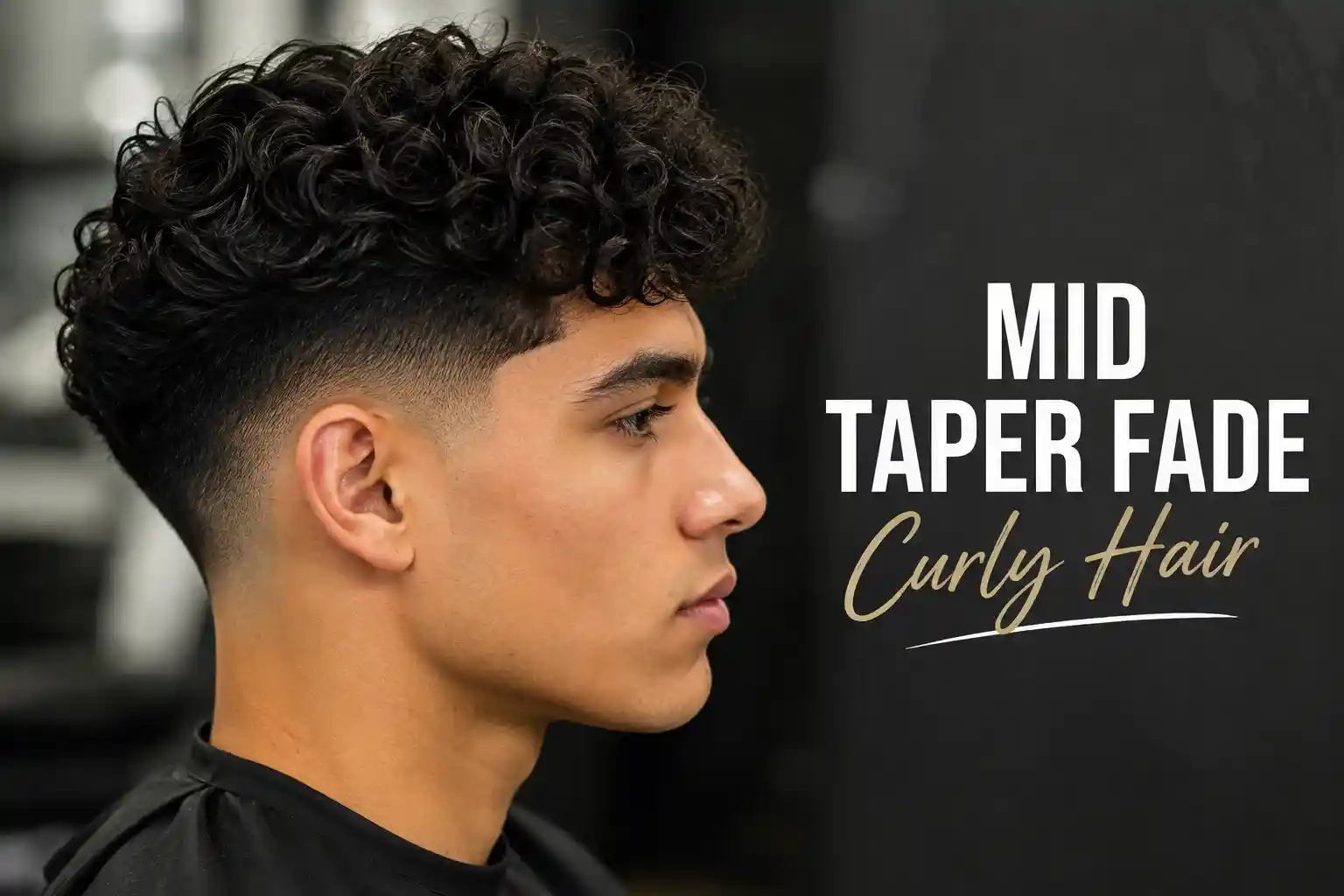
Curly hair grows outward before it grows down, so an untrimmed cut turns into a triangle shape at the sides. That widens your head and buries your curl pattern under bulk. A mid taper fade curly hair cut solves this by trimming the sides while leaving your curls full on top. Here is exactly how to get it right, from the barber chair to your bathroom mirror.
What Is a Mid Taper Fade Curly Hair Cut?
A mid taper fade curly haircut starts blending at the midpoint between your ear and your hairline. The sides gradually shorten toward the neckline and around the ears, while the top keeps enough length for your natural curl pattern to sit, bounce, and hold shape.
It sits between two other common options:
- Low fade: Blending starts near the ear, leaving more length on the sides.
- High fade: Blending starts near the temple, removing far more bulk.
The mid position works for most face shapes because it balances the head without cutting too close to the skin.
Why Curly Hair Pairs So Well With a Mid Taper Fade
Curls carry more volume than straight strands, so side length adds up fast. This fade style removes that extra width while your curls stay untouched on top. The result is a defined silhouette instead of a shapeless puff.
Three specific benefits show up right away:
- Less daily maintenance. Short sides need almost no styling between washes.
- Sharper definition on top. Your curl pattern reads clearly once the sides stop competing for attention.
- Faster drying time. Less hair on the sides means your whole head dries quicker after a wash.
Fade Height Comparison Table
Use this table to see exactly how the mid fade stacks up against nearby options before your appointment.
| Fade Type | Blend Start Point | Best For | Maintenance Frequency | Skill Level Needed |
| Low Taper Fade | Just above the ear | Thicker curls, conservative styles | Every 3–4 weeks | Beginner-friendly |
| Mid Taper Fade | Halfway between ear and temple | Most curl types and face shapes | Every 2–3 weeks | Moderate |
| High Taper Fade | Near the temple | Bold, sharp looks | Every 2 weeks | Advanced |
| Skin Fade | Blends to bare skin | Maximum contrast | Every 1–2 weeks | Advanced |
| Curly Undercut | Sharp line, no blend | Thick 4A–4C curls | Every 3–4 weeks | Moderate |
Best Mid Taper Fade Curly Hair Styles by Curl Type
Curl patterns behave differently, so the top length your barber leaves should change with your texture. Here is what typically works best for each type.
- 2A–2C (loose waves): Leave 2–3 inches on top for movement and a soft curtain or side-swept finish.
- 3A–3B (springy curls): Keep 2–4 inches so curls have room to coil and bounce without collapsing.
- 3C–4A (tight curls): A rounded, boxy top shape holds these curls in a defined dome.
- 4B–4C (coily hair): Shorter, even length on top with a sharp mid fade line creates a clean, low-effort look.
If you are unsure of your curl type, wet a small section of hair and let it air dry without touching it. The shape it forms on its own is your natural pattern.
How to Ask Your Barber for a Mid Taper Fade Curly Hair Cut
Vague requests lead to uneven results. Bring this exact script to your next appointment:
“I’d like a mid taper fade curly hair cut. Start the blend halfway between my ear and temple, fade it down to my neckline, and keep the top long enough to hold my curl pattern. Please use scissors or clippers over comb on top, not a razor, so my curls stay healthy.”
Mentioning your curl type and the last time you had a fade also helps the barber judge how much bulk needs to come off.
Step-by-Step: What Happens During the Appointment
Knowing the process removes the guesswork and helps you spot a rushed cut before it happens.
- Consultation. The barber checks your curl density, growth direction, and face shape.
- Dry or damp assessment. Curly hair is often cut dry first, since curls shrink and shift when wet.
- Guard selection. For the fade zone, the barber selects clipper guards, usually a #2 to #4 blend.
- Blending. Clipper-over-comb or shear-over-comb work smooths the transition from short sides to a longer top.
- Top shaping. Curls are shaped with shears to control weight and curl bounce.
- Line-up. The hairline, temples, and neckline get sharpened with a trimmer or straight razor.
- Final check. A quick wet-down shows how the curls settle before you leave the chair.
Best Products to Maintain a Mid Taper Fade Curly Hair Look
The right products keep the sides sharp and the curls on top defined between visits.
- Curl cream or custard: Defines curl pattern without stiffness.
- Lightweight gel: Locks curl shape while drying, then rinses out without flaking.
- Leave-in conditioner: Prevents frizz and keeps strands flexible for styling.
- Beard or edge balm: Keeps the taper line looking sharp between trims.
- Silk or satin pillowcase: Reduces friction on curls overnight.
According to the American Academy of Dermatology, curly hair is more prone to dryness and breakage than straight hair, so moisture-focused products matter more here than on other cuts.
Daily Styling Routine for This Cut
A short, repeatable routine keeps the look consistent without eating up your morning.
- Mist curls lightly with water if they look flat or dry.
- Apply a small amount of curl cream, scrunching upward from the ends.
- Add a few drops of gel for hold if you have an active day ahead.
- Use a diffuser on low heat or let curls air dry.
- If necessary, use a light finishing balm to touch up the fade.
Skip daily washing. Dermatologists recommend washing curly hair only every two to three weeks at minimum, since curls hold natural oils longer than straight hair and over-washing strips moisture.
How Often Should You Trim a Mid Taper Fade Curly Hair Cut?
The sides grow out faster than the top visually, since even small growth blurs a sharp blend line.
- Fade touch-up: Every 2–3 weeks to keep the blend crisp.
- Top trim: Every 6–8 weeks to remove split ends without losing length.
- Full reshape: Every 3–4 months, or when the top starts overwhelming the fade.
Skipping fade touch-ups is the fastest way to lose the clean look that makes this cut worth getting in the first place.
Cost Breakdown for This Haircut
Pricing depends heavily on location and barber experience, but here is a realistic range based on typical U.S. barbershop pricing.
| Service Level | Price Range | What’s Included |
| Budget barbershop | $20–$35 | Basic fade, no styling |
| Mid-range barbershop | $35–$55 | Fade, top shaping, line-up |
| Specialty curl barber | $55–$90 | Curl-specific consultation, dry cut, styling |
| Premium salon | $90–$150+ | Full service, product application, styling tutorial |
Ask specifically for a barber who lists curly or textured hair as a specialty. This cut, when performed by someone unfamiliar with curl behavior, often ends up uneven once the curls dry and shrink.
Common Mistakes That Ruin This Haircut
Avoid these errors to protect your investment in the cut.
- Cutting curls wet only. Curls shrink as they dry, so a wet-only cut often ends up shorter than planned.
- Using a razor on top. Razors can cause frizz and split ends on curly strands.
- Skipping fade touch-ups. Growth blurs the taper line within three weeks.
- Over-washing. Daily washing strips the natural oils curls need to stay defined.
- Ignoring face shape. A top that’s too long or too short can throw off facial proportions.
Mid Taper Fade Curly Hair for Different Face Shapes
Matching the top length and side height to your face shape sharpens the overall result.
- Round face: Keep more height on top and a slightly higher fade to add length visually.
- Square face: A rounded curl shape on top softens strong jawlines.
- Oval face: Nearly any top length works, giving the most styling freedom.
- Long face: Keep the top shorter and the fade lower to avoid adding extra height.
- Heart-shaped face: Balance a narrower chin with fuller curls near the temples.
Entities and Terms Worth Knowing
A few related terms come up often when discussing this style with a barber or researching further:
- Taper vs. fade: A taper blends gradually; a fade blends down to skin. This style typically uses a soft taper rather than a full skin fade.
- Curl density: How many strands grow per square inch, affecting how much bulk needs removing.
- Shrinkage: How much shorter curls appear once dry compared to their stretched length.
- Line-up: The sharp edge cut around the hairline and temples.
FAQs
1. Does a mid taper fade work on all curl types?
Yes. A mid taper fade curly hair cut adapts to loose waves, springy curls, and tight coils. The main variable is how much length the barber leaves on top, not whether the fade itself will work.
2. How long does a mid taper fade curly hair cut take to grow out?
The fade starts blurring within 2–3 weeks, while the overall shape stays wearable for about 8–10 weeks before a full reshape is needed.
3. Can I get this fade with a beard?
Yes, and many barbers recommend connecting the fade into the beard line for a more unified look. Mention this during your consultation so the barber blends both areas together.
4. Is a mid taper fade curly hair cut low maintenance?
The sides require almost no daily effort. The top needs a short curl routine using cream or gel, but overall this cut is easier to maintain than longer curly styles.
5. Should curly hair be cut wet or dry for a mid taper fade?
Most barbers cut curly hair dry first to see the true curl pattern and shrinkage, then refine the lines once the hair is slightly damp.
6. How much does a mid taper fade curly hair cut cost on average?
Expect to pay between $35 and $90 depending on your barber’s experience with curly and textured hair, with specialty curl barbers charging toward the higher end.
Conclusion
A mid taper fade curly hair cut gives you a clean, balanced shape without forcing your curls into a style they were never meant to hold. Bring the barber script above to your next appointment, stick to the trim schedule, and keep a short product routine on hand.
Book your next cut with a barber who lists curly hair as a specialty, and ask them to walk through the blend with you before the clippers start.