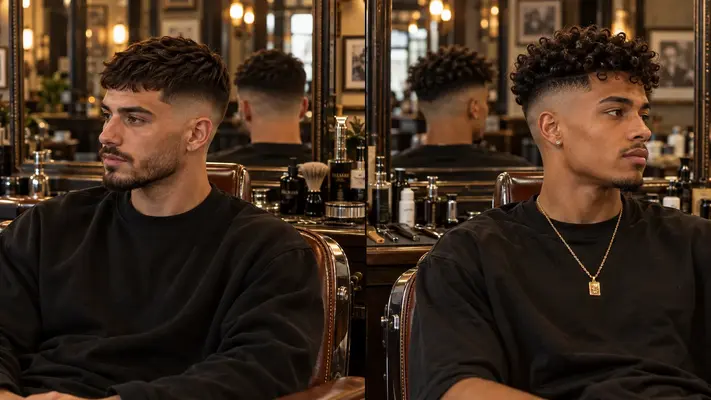
You sit in the barber chair and hear the question: “What kind of fade?” Your mind goes blank. Picking the wrong fade throws off your entire look and leaves you regretting the cut for weeks. This guide settles the low fade vs high fade debate once and for all so you walk out looking sharp every single time.
What Exactly Is a Fade Haircut?
A fade haircut gradually blends your hair from short to even shorter, often down to bare skin. The transition creates a clean, polished appearance that works with nearly every hair type and texture. Barbers use clippers at different guard lengths to build this seamless gradient along the sides and back of your head.
Fades rose to mainstream popularity in the 1980s and 1990s. Today they remain the most requested men’s haircut worldwide because of their versatility and clean finish.
Understanding the Low Fade
A low fade starts the blending process just above the ear. The transition zone sits close to the neckline, which keeps more hair on the sides. This subtle approach gives you a conservative yet modern appearance.
Men with round or square face shapes benefit most from this style. The extra length on the sides adds balance without widening your face. When comparing a low fade haircut vs high fade, the low option wins for professional and office environments.
Understanding the High Fade
A high fade begins the blend near the temple or even higher on the head. Most of the side hair disappears quickly, leaving a dramatic contrast between the top and the sides. This bold style grabs attention and pairs well with textured tops, curls, or pompadours.
The high fade vs low fade haircut choice leans toward the high version when you want maximum visual impact. Athletes, creatives, and younger men often gravitate toward this edgy look.
Low Fade vs High Fade: Key Differences at a Glance
| Feature | Low Fade | High Fade |
| Starting Point | Just above the ear | Near the temple or higher |
| Side Hair Length | More hair remains | Very little hair remains |
| Contrast Level | Subtle and soft | Bold and dramatic |
| Best Face Shape | Round, square, oval | Oblong, diamond, heart |
| Maintenance Cycle | Every 3–4 weeks | Every 2–3 weeks |
| Professional Setting | Highly appropriate | Depends on workplace |
| Styling Effort | Minimal | Moderate to high |
| Grow-Out Phase | Blends naturally | Shows lines quickly |
Low vs Mid vs High Fade: Where Does the Mid Fade Fit?
The low vs mid vs high fade spectrum gives you three distinct options to consider. A mid fade starts around the middle of the ear, splitting the difference between subtle and bold. Think of it as the safe middle ground when you cannot decide.
The full low fade vs mid fade vs high fade breakdown helps you match the fade height to your personal style and daily routine. Conservative dressers pick low. Trendsetters pick high. Everyone else arrives in the center with ease.
When you expand the comparison to a low vs medium vs high fade, the medium option offers the most forgiving grow-out period. You can stretch your barber visits by an extra week without looking unkempt.
Low Taper Fade vs High Taper Fade Explained
A taper fade keeps the hairline and sideburns intact while blending only the lower portion near the ears and neckline. The low taper fade vs high taper fade distinction mirrors the standard fade comparison but delivers a softer, more natural finish.
Taper fades grow out more gracefully, which means fewer barber visits and lower maintenance costs (Milan Laser, Men’s Fade Haircut Guide). If you compare a low taper vs high taper fade, the low taper suits men who want a barely-there blend that stays neat for weeks.
High Taper Fade vs Low Taper Fade: Which Grows Out Better?
The high taper fade vs low taper fade question matters most three weeks after your cut. A low taper maintains its shape longer because the blending zone sits lower and stays hidden. A high taper starts to look uneven faster since the contrast zone is more visible.
When you weigh a high vs low taper fade, plan your barber schedule around your chosen style. Budget-conscious men often prefer the low taper route for this exact reason. The low vs high taper fade decision also affects how your hair looks in photos and video calls.
Low Taper Fade vs High Fade: Can You Mix Styles?
Yes, you can combine elements from different fade types. A low taper fade vs high fade comparison shows that a low taper on the sides with a high skin fade on the back creates a unique hybrid look. Many barbers call this a “drop fade” or “burst fade” variation.
This mixed approach works especially well for men who want a clean neckline but prefer keeping more length around the ears. Discuss this option with your barber during the consultation.
Low Fade vs High Fade for Black Hair Textures
The low fade vs high fade black hair discussion deserves special attention. Tight curls, coils, and kinks respond beautifully to both styles, but the visual effect differs significantly. A high fade creates striking contrast against a full curly top, while a low fade frames the face with more volume on the sides.
Barbers who specialize in textured hair can adjust the blend to complement your specific curl pattern. Ask for a consultation before committing to either option. The low vs high fade choice on textured hair also depends on how much daily styling you want to do.
Face Shape Guide: Matching Your Fade to Your Bone Structure
Your face shape plays a bigger role than most men realize. Here’s a brief guide to aid in your decision:
- Oval face: Any fade height works. You have the most flexibility across all styles.
- Round face: A high vs low fade choice that keeps some side length works best. A low or mid fade prevents your face from looking wider.
- Square face: A mid or high fade softens a strong jawline and adds height on top.
- Oblong face: Stick to a low fade. High fades add vertical length you do not need.
- Heart face: A high vs mid vs low fade selection should land on low or mid to balance a narrow chin.
- Diamond face: A high fade vs mid fade vs low fade evaluation points toward a mid fade that adds width at the temples.
How to Talk to Your Barber About Fade Height
Clear communication prevents disappointment. Tell the barber just where you want the blend to begin. Point to the spot above your ear or near your temple. Use reference photos whenever possible.
Ask your barber to show you the difference between a low vs mid vs high taper fade on your specific head shape before they start cutting. A skilled barber will gladly explain the options and recommend what suits your bone structure (Barber Surgeons Guild, Men’s Grooming Guide).
How to Maintain Your Fade to Keep It Looking New
Fades lose their sharpness fast. Follow these steps to extend the life of your cut:
- Wash your hair with a gentle shampoo two to three times per week.
- To maintain the top’s texture and definition, use a light styling product.
- Brush the sides daily to train the hair growth direction.
- Book your next appointment within two to four weeks depending on fade height.
- Avoid heavy gels that flatten the gradient effect and clog hair follicles.
- Sleep on a satin pillowcase to reduce friction and preserve the blend.
Low Fade vs High Fade Haircut: Final Styling Recommendations
The low fade vs high fade haircut decision ultimately comes down to your lifestyle and personal taste. Office workers and men in formal industries look polished with a low fade. Creative professionals and students can pull off a high fade with confidence.
Consider your morning routine too. A high vs low fade paired with a messy top takes less styling time than a slicked-back look combined with a low fade. The low fade vs high fade choice should simplify your life, not complicate it.
Conclusion
Your haircut speaks before you do. Now that you understand every angle of the low fade vs high fade conversation, stop guessing in the barber chair. Pick the fade that matches your face shape, lifestyle, and personal style.
Book that appointment, show your barber this guide, and walk out with a cut that turns heads for all the right reasons. You only need to make one choice to get your finest look.
Featured Guides
Hand‑picked articles to level up your style & grooming
Golden Doodle Haircuts: Cute & Low‑Maintenance Styles
Grooming guide · Breed‑specific styles · Easy upkeep routines for your Goldendoodle.
Read Guide
1940s Haircut Male: Classic Styles & Modern Twists
Vintage barbering · Pompadour & side part · How to get the 1940s look today.
Read Guide
High Top Haircut Curly: Bold 80s Style Guide
Volume & height · Curl definition · How to style and maintain a high top fade.
Read Guide