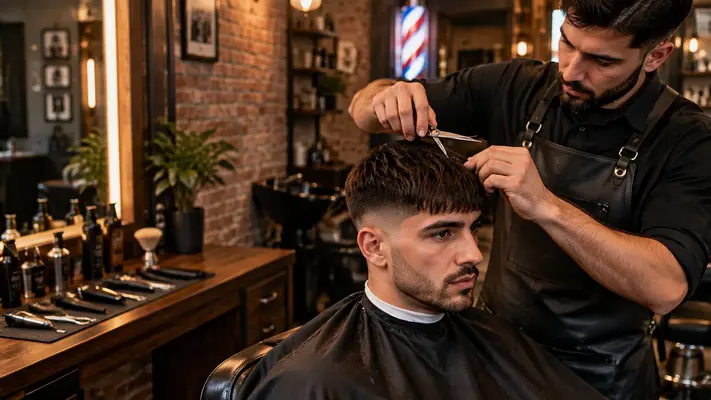
Your barber has probably suggested it at least once, and you probably nodded politely and asked for “the usual” instead. That’s a shame, because caesar cut haircuts have quietly become one of the most requested cuts in barbershops right now, and once you understand why, you’ll wonder why you waited.
This guide breaks down every version of the cut, where it actually came from, which one fits your hair type and hairline, and how to ask for it without getting a style you didn’t want.
What Is a Caesar Cut, Exactly?
At its core, the caesar cut hairstyle is short hair on top, combed forward into a horizontal fringe, with the sides trimmed close or faded. There’s no parting, no swept-back styling, and almost no daily effort required.
Ask ten people what is a caesar haircut and you’ll get ten slightly different answers, because the cut has quietly split into several sub-styles over the decades. What stays constant is the forward-brushed fringe and the clean, cropped sides.
It’s the kind of caesar cut hairstyle that works in an office, a gym, and a night out without changing anything about it. That versatility is a big part of why it never really goes out of fashion.
Also Searched As: The Spelling Confusion
Because the name comes from a person, not a barbering term, it gets spelled a dozen different ways online. If you’ve typed ceasar haircut, ceaser haircut, cesar haircut, or caeser haircut into Google, you landed in the right place — they’re all the same style.
The same goes for corte cesar (the Spanish-language search term), caesars haircut, hairstyle caesar, or even caesar hair cut written as two words instead of one. Barbers use these interchangeably, so don’t stress over the spelling when you’re booking your appointment.
Where the Caesar Cut Actually Comes From
The style is named after Julius Caesar, and the julius caesar haircut legend claims he wore his hair forward to hide a receding hairline. Historians argue the details, but the visual — short, forward-combed hair — is well documented in Roman busts and coins.
That’s also why some barbers still call it a gladiator haircut, tying it to the same era of Roman imagery. The julius caesar hairstyle resurfaced hard in the 1990s, largely thanks to George Clooney’s role on ER, which is why plenty of guys still search caesar haircut 90s when describing the look they want.
The julius caesar hair reference isn’t just trivia. It explains why the cut sits forward instead of back, and why it flatters a receding hairline better than almost any other short style.
Classic Caesar vs. Modern Caesar: What’s Different Now
Not every caesar cut looks the same today, and knowing the difference before your appointment saves you from a haircut you didn’t ask for.
The Classic Caesar
The classic caesar cut keeps things uniform: even length across the top, a straight-across fringe, and short sides with minimal contrast. It’s the version closest to the original 90s look, and the classic caesar haircut still gets requested by guys who want something clean without any trendy detailing.
The Modern Caesar
The modern caesar cut adds texture, slightly longer length on top, and often a fade on the sides for contrast. A modern caesar haircut might include choppy, razored ends instead of a blunt line, giving it movement rather than a flat cap-like finish.
Some barbers push this further into a modern messy caesar haircut, where the top is deliberately tousled rather than combed flat. If you scroll barber Instagram pages, most of what you’ll see labeled “caesar haircut modern” or simply “modern caesar” falls into this messier, textured category rather than the original strict version.
Caesar Cut Length Options
Length changes the whole personality of the cut, and it’s worth deciding this before you sit in the chair.
- Short caesar cut — tight, low-maintenance, closest to military styling
- Long caesar haircut — more length on top for texture and movement, sometimes styled with product
- Low caesar haircut — sides cut very close, almost skin-level, for maximum contrast
A short caesar haircut suits guys who don’t want to touch their hair in the morning. Caesar haircut short versions are also popular with athletes because sweat and helmets don’t ruin the style. On the other end, a long caesar cut (sometimes just called caesar haircut long) gives stylists room to add waves, texture, or a slight quiff at the front.
If you’ve seen the term short cesar cut or low cut caesar floating around forums, they’re describing this same length spectrum, just with the common spelling variations mixed in. A low cut caesar haircut specifically refers to very short sides paired with the classic forward fringe — barbers sometimes just shorten this to “low caesar” when talking to regulars.
Caesar Cut With Fade: The Most Requested Combo
Pairing the top with a fade is now the default rather than the exception, and it’s the single most common request barbers get.
- Caesar haircut fade — a graduated fade from the sides up into the top length
- Caesar cut fade — same concept, different phrasing barbers use interchangeably
- Caesar fade haircut — often used to describe a high-contrast skin fade specifically
A caesar fade blends the sides down to nothing, letting the forward fringe stand out as the main feature. Ask for a caesar haircut with fade and most barbers will default to a mid-length fade unless you specify otherwise — always mention if you want it higher or lower.
For guys who want subtlety, a caesar cut low fade keeps the blend close to the hairline rather than climbing up the sides, and a dark caesar fade (on darker hair colors) tends to hide the transition line better than lighter shades. If you’d rather skip the fade entirely, ask specifically for caesar cut no fade or caesar haircut no fade — otherwise most shops fade it by default. Cesar fade is simply the same request with the common spelling swap.
Color, Texture, and Hair Type Variations
The cut adapts across hair colors and textures more than people expect.
| Variation | Best For | Maintenance |
| Dark caesar haircut | Dark or black hair, high contrast fades | Medium |
| Light caesar cut | Blonde or light brown hair, softer fringe | Low |
| Black caesar cut | Very short, tightly cropped styling | Low |
| Textured caesar cut | Thick or wavy hair | Medium-High |
| Curly caesar cut | Naturally curly hair | High |
A dark caesar cut (also written dark caesar hair or dark ceaser) tends to show the fade line more sharply, which is why barbers usually blend it a little longer to soften the contrast. A dark cesar haircut on jet-black hair photographs especially well, which explains why it’s everywhere on social media right now.
On the flip side, a caesar black haircut or caesar haircut black refers to hair color rather than styling technique — some clients use “black caesar haircut” to mean the same thing. For men specifically searching caesar cut black men or caesar haircut black men, the main adjustment barbers make is a slightly tighter fade to define the shape against coarser or curlier textures.
If your hair naturally curls, a curly caesar cut needs different handling than straight hair. Instead of combing the fringe flat, barbers work with the curl pattern, which is where caesar cut curly hair guides usually start. A textured caesar cut, meanwhile, uses point-cutting or texturizing shears to add movement to straight or wavy hair that would otherwise look too flat.
Best Caesar Cuts for Different Guys
Not every version suits every face, hair density, or hairline, so here’s the honest breakdown.
For thinning hair or hair loss:
- Caesar cut for balding men keeps length short enough that thinning patches blend rather than stand out
- Caesar cut for receding hairline (or caesar haircut receding hairline) uses the forward fringe to visually soften the hairline, the same trick Julius Caesar himself is said to have used
For general everyday wear:
- Caesar cut men and men’s caesar cut are just general phrasing for the standard style
- Mens caesar cut, men’s caesar haircut, mens caesar haircut, and men caesar haircut are all the same search, just typed differently
- Caesar cut for men, caesar haircut for men, and caesar haircuts for men cover guys looking for barber references or before-and-after photos
- Caesar haircut men is often used specifically when comparing barber portfolios
Faded by casear is a phrase that pops up in search data too, almost always meaning the same fade-plus-fringe combination described above, just typed in a hurry.
Caesar Cut vs. French Crop: Which One Should You Get?
This comparison comes up constantly, and the caesar cut vs french crop debate really comes down to one detail: fringe shape.
A caesar cut brushes the fringe straight down and across the forehead in one continuous line. A French crop does the same short-sides, textured-top combination but leaves the fringe slightly choppier and often shorter, sitting higher on the forehead. If you want maximum forehead coverage, go caesar. If you want a slightly edgier, less uniform fringe, the French crop is the better ask.
How to Get the Cut Right at the Barbershop
Knowing how to give yourself a caesar cut at home is possible with clippers and a steady hand, but most guys get better results letting a barber handle the caesar hair cutting process, especially the fringe line.
- Show reference photos — spelling variations mean barbers might picture something different than you do
- Specify fade height and whether you want it blended or a hard line
- Ask for the fringe length you want — shorter fringes need more frequent trims
- Mention your hair type so they adjust technique for curly or thick hair
- Book a trim every 3-4 weeks — this caesar hair cut only looks sharp when it’s fresh
The caesar style haircut lives and dies by that fringe line, so don’t rush this conversation with your barber. A slightly-off fringe changes the entire look of the caesar hairstyle, and it’s the detail most guys forget to discuss before the clippers come out.
Frequently Asked Questions
What is a caesar haircut called at the barbershop?
Most barbers just call it a caesar cut or caesar haircut, though some shops list it as a “Roman crop” or “gladiator haircut” on their menu. Showing a photo is still the safest way to avoid confusion.
How often do I need to trim a caesar cut?
Every 3 to 4 weeks. The fringe grows out fastest and starts covering the eyebrows, which is usually the first sign it’s time for a refresh.
Does the caesar cut work with curly hair?
Yes, though a curly caesar cut needs a barber who understands curl patterns. The fringe won’t sit flat like it does on straight hair, and that’s expected, not a mistake.
Is a caesar cut good for a receding hairline?
It’s actually one of the better options. The forward fringe visually lowers the hairline instead of exposing it, which is part of why the julius caesar haircut became associated with hiding hair loss in the first place.
What’s the difference between a caesar cut and a French crop?
The caesar cut has a straight, full fringe brushed forward. The French crop’s fringe sits higher and choppier. Both use short, often faded sides.
Can I add a fade to a caesar cut?
Absolutely, and most guys do. A caesar haircut fade or caesar cut with fade is now more common than the no-fade classic version, especially in barbershops that specialize in modern cuts.
Will a caesar cut suit thick or curly hair?
Yes, but expect your barber to texturize it. A textured caesar cut or caesar cut curly hair adaptation uses thinning shears so the top doesn’t look bulky once it grows past the initial trim.
Conclusion
If you want a haircut that looks intentional without needing fifteen minutes and three products every morning, this is it. Whether you end up asking for the classic version, a heavy fade, or a messy modern take, the caesar cut earns its reputation because it solves a real problem — looking sharp without the daily effort.
Bring a photo, mention your hair type, and let your barber pick the fade height. That’s really the whole trick.