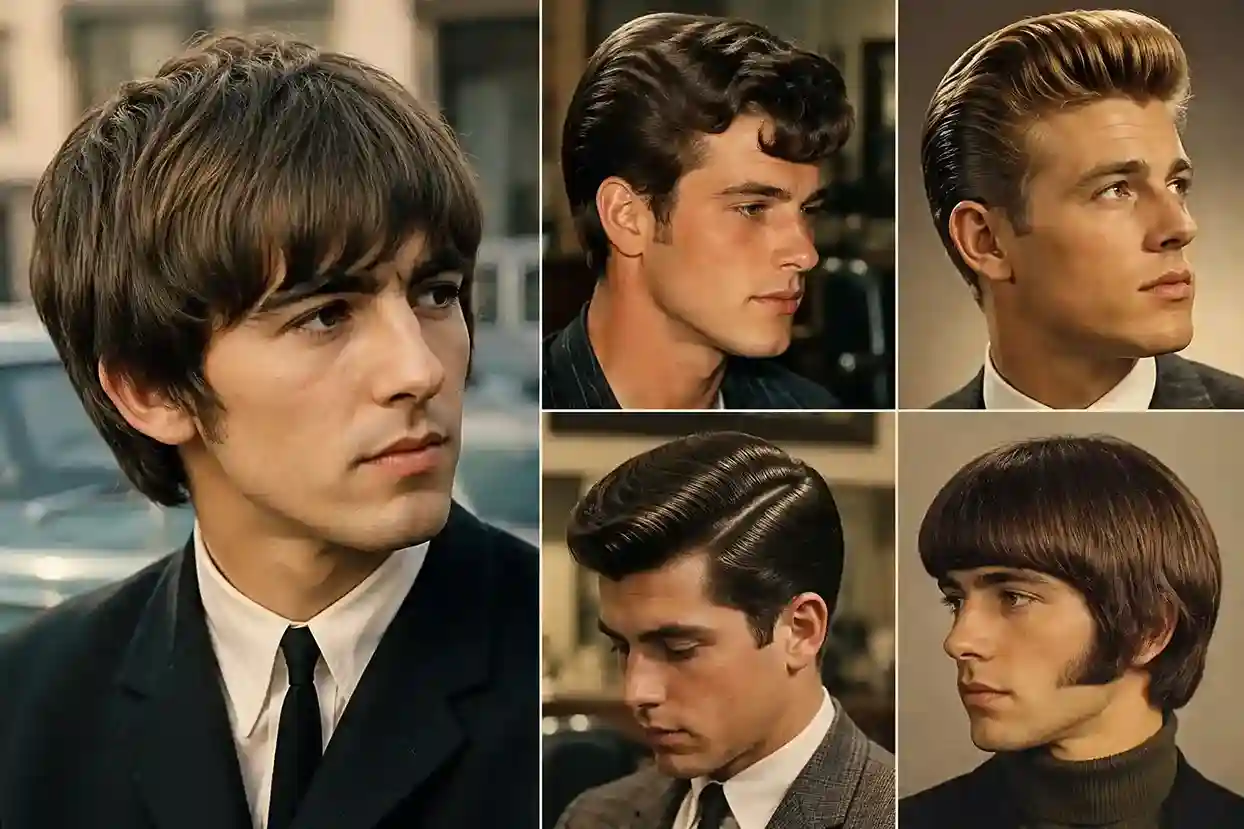
Finding an authentic 1960s haircut online usually means scrolling past blurry photos with no names and no real history behind them. That makes it hard to ask a stylist for the right cut or know if a look will actually suit you. This guide solves that problem directly. Below is every major men’s and women’s 1960s haircut, explained clearly, with sources and styling advice you can use today.
What Made 1960s Haircuts So Iconic?
The 1960s changed hair the way it changed music, fashion, and film. Young people had more spending power than any generation before them, and they used it to reject their parents’ rigid, salon-set styles. By the late 1960s, fashion sanctioned longer hair for both men and women, and style overall had become far more theatrical than the decade before.
Two cultural groups pushed this shift early on. The Beatniks and the Mods (short for “Modernists”) were especially influential in the first half of the decade, and Mods in particular shaped the look of bands like The Who, The Small Faces, and The Beatles. Their haircuts spread from London clubs to American high schools within a few years.
This is why 1960s haircuts still matter today. They represent the first time hair became a personal statement rather than an inherited style passed down from a parent’s generation.
Men’s 1960s Haircuts: Classic Styles Every Guy Wore
Mens 1960s haircuts fell into two broad camps: the clean, structured looks left over from the 1950s, and the longer, freer styles that arrived with British rock bands. Early in the decade, short and tidy ruled. By 1967, shaggy layers had taken over.
Popular mens haircuts 1960s included:
- The Princeton cut – short sides, longer swept-back top
- The crew cut – close, uniform length all over
- The pompadour – volume at the front, combed back
- The Beatle cut – a moptop with a heavy fringe
- The shag – layered, textured, and slightly messy
Each style signaled something different. A Princeton cut said “college campus” or “office job.” A Beatle cut said “I listen to rock and roll.” Understanding this range helps explain why 1960s mens haircuts varied so much from city to suburb.
The Princeton Haircut 1960s: Ivy League Style Explained
The Princeton haircut 1960s style is a refined crew cut with slightly longer hair on top, usually one to two inches, left long enough to comb into a side part. It’s also known as the Ivy League or the Harvard Clip, and it’s a type of crew cut where the hair on the top front of the head is long enough to part at the side while the crown stays short.
This 1960s mens haircut carried real social weight. It was the go-to look for college students, young professionals, and anyone who wanted to appear polished without looking overly formal.
How to ask for it today:
- Tell your barber to keep the sides tight (clipper guard #1 or #2)
- Leave 1.5 to 2 inches of length on top
- Request a natural side part, not a hard shaved line
- Style with a light pomade for hold without shine
1960s Short Haircuts for Men: Crew Cuts and Beyond
Not every man embraced longer hair, and 1960s short haircuts remained common through the middle of the decade, especially in workplaces, the military, and conservative communities.
The classic short options included:
| Style | Length | Best For | Maintenance |
| Crew cut | Very short, uniform | Active lifestyles, hot climates | Trim every 2-3 weeks |
| Flat top | Short sides, flat top | Bold, structured looks | Trim every 2 weeks |
| Princeton | Short sides, longer top | Office and campus settings | Trim every 3-4 weeks |
| Butch cut | Extremely short overall | Low-maintenance routines | Trim every 3 weeks |
These 1960s haircuts men chose reflected a simple trade-off: less styling time in exchange for a sharper, more disciplined appearance.
Women’s 1960s Haircuts: From Bouffant to Bob
Women’s hair went through the biggest transformation of the decade. The early 1960s still favored teased, sprayed bouffants that took real effort to maintain. By mid-decade, that had reversed completely.
Vidal Sassoon led this change. When Sassoon picked up his shears in the 1950s, styled hair was typically curled, teased, piled high, and shellacked into place — then came the 1960s and his creative cuts, which required little styling and fell into place perfectly every time. He described his goal simply: to cut shape into the hair, use it like fabric, and remove everything superfluous, because women were returning to work and no longer had time to sit under a dryer.
This single shift explains most 1960s haircuts female clients requested for the rest of the decade: wash-and-wear styles that needed a great cut, not a great deal of upkeep.
The 1960s Bob Haircut: Vidal Sassoon’s Game-Changer
The 1960s bob haircut is arguably the single most influential women’s hairstyle of the decade. Sassoon cut actress Nancy Kwan’s long hair into a new bob in 1963, keeping the back short with longer, layered sides, and photographer Terence Donovan’s profile shot of the result became a classic image published in British Vogue. Sassoon later called it a turning point in his career, saying fashion editors started calling him to discuss creative sessions rather than simply dictate instructions.
A year later, Sassoon pushed the idea further. He created the Five Point Cut, first on British Vogue’s Clare Rendlesham, working with designer Mary Quant and models including Peggy Moffitt and Grace Coddington.
1960s bob haircuts typically featured:
- A blunt, geometric edge rather than soft layers
- Chin-to-jaw length for most versions
- Minimal reliance on curling irons or rollers
- A shape that moved and fell back into place on its own
If you want an authentic version now, ask for a “geometric bob with a blunt line” rather than a generic layered bob, since most modern bobs use softer, feathered edges.
The Pixie Haircut 1960s: Short and Bold
The pixie haircut 1960s women wore was a direct extension of the Sassoon philosophy: short, precise, and low-maintenance. Unlike the soft pixie cuts common today, the original 1960s pixie haircut had sharper lines and closer cropping around the ears and neck.
This cut worked especially well with the era’s bold makeup and simple, structured clothing. It also became a quiet political statement, since short hair on women had long been associated with rebellion against traditional femininity.
A pixie haircut 1960s look pairs well with:
- Defined brows and winged eyeliner
- Simple, minimal earrings
- Structured mod-style dresses
- Little to no daily styling product
The 1960s Shag Haircut: Rock and Roll Texture
The 1960s shag haircut arrived later in the decade and carried an entirely different energy from the polished bob and pixie. It was layered, textured, and intentionally imperfect, influenced heavily by rock musicians and the emerging counterculture movement.
Key features of the 1960s shag haircut included:
- Heavy layering throughout, especially around the crown
- A rounded, feathered fringe
- Length that could range from shoulder to mid-back
- A tousled finish rather than a sleek, combed one
This style suited both men and women, which made it one of the more gender-flexible cuts of the era. Bands and their audiences often wore near-identical versions of it.
The Pageboy Haircut 1960s: Soft and Sophisticated
The pageboy haircut 1960s style sits between the structured bob and the looser shag. It features hair turned under at the ends, creating a smooth, rounded silhouette that typically falls between the chin and shoulders.
Unlike the sharp-edged bob, the pageboy haircut 1960s version relied on soft curves and a rounded fringe. It was a favorite among younger women and teenagers because it looked neat without requiring a daily blowout.
Simple styling steps for a modern pageboy:
- Blow-dry hair with a round brush, rolling ends under
- Set with a light-hold spray while still warm
- Keep a blunt, rounded fringe if you want the full period look
- Touch up ends every 4-6 weeks to maintain the shape
1960s Haircuts: Complete Style Comparison Table
Use this table as a quick reference before your next salon or barber visit.
| Haircut | Gender | Signature Feature | Popularized By | Modern Equivalent |
| 1960s bob haircut | Women | Blunt, geometric edge | Vidal Sassoon | Textured bob |
| 1960s pixie haircut | Women | Short, sharp crop | Mia Farrow, Twiggy | Modern pixie |
| 1960s shag haircut | Men & Women | Heavy layers, tousled | Rock musicians | Modern shag |
| Pageboy haircut 1960s | Women | Turned-under ends | Teen fashion trends | Rounded lob |
| Princeton haircut 1960s | Men | Short sides, longer top | Ivy League students | Ivy League fade |
| Crew cut | Men | Uniform short length | Military and workwear | Buzz cut |
| Beatle cut | Men | Moptop with fringe | The Beatles | Modern fringe cut |
| Beehive/Bouffant | Women | Height, heavy teasing | Early 1960s salons | Rarely worn today |
How to Get a 1960s Haircut Today
Bringing a reference photo helps, but the right words matter more. Stylists respond better to specific, technical language than to vague descriptions like “something retro.”
When booking your appointment, try this approach:
- Name the exact style (bob, pixie, shag, Princeton, pageboy)
- Mention whether you want blunt or feathered edges
- Bring one clear reference photo, ideally in good lighting
- Ask about maintenance before you commit to a shorter cut
A short 1960s haircut men or women wore back then still needs trims every three to five weeks today to hold its shape, so factor that into your decision.
Products and Tools Used for 1960s Hairstyles
The tools of the era were simpler than what’s available now, but they still matter if you want an authentic finish.
- Setting lotion – used for structured curls and waves
- Teasing comb – for volume in bouffant and beehive styles
- Round brush and hood dryer – for smooth pageboy and bob finishes
- Light pomade or wax – for men’s Princeton and pompadour styles
- Hairspray with firm hold – essential for anything with height
Modern versions of these tools work just as well. A round brush and a light-hold spray will recreate most of these looks without needing vintage equipment.
Celebrities and Icons Who Defined 1960s Haircuts
Certain public figures made specific cuts famous almost overnight. Their influence is part of why these styles remain recognizable decades later.
- Twiggy – short, cropped pixie that defined the mod look
- Mary Quant – wore and popularized the Five Point cut
- Nancy Kwan – inspired Sassoon’s breakthrough bob
- The Beatles – made the moptop a global phenomenon
- John F. Kennedy – helped popularize the Princeton haircut in American men’s fashion
Each of these figures shows how closely these cuts were tied to music, film, and public life rather than salon trends alone.
How to Choose the Right 1960s Haircut for Your Face Shape
Not every 1960s style suits every face, and picking the wrong one can make styling harder than it needs to be.
- Round faces – the bob and pageboy add length and structure
- Square faces – the shag softens strong jawlines with layers
- Oval faces – almost any 1960s cut works, including the pixie
- Heart-shaped faces – the Princeton or a side-swept pageboy balances a narrower chin
A quick consultation with your stylist before cutting can confirm which option will work best with your natural texture and growth pattern.
Frequently Asked Questions
What was the most popular haircut in the 1960s?
The bob haircut, especially Vidal Sassoon’s geometric version, was the most influential women’s style, while the Princeton cut led men’s fashion through most of the decade.
What is a 1960s bob haircut called?
It’s often called a Sassoon bob or geometric bob, named after Vidal Sassoon, the stylist who popularized its precise, blunt-edged shape.
Did men wear long hair in the 1960s?
Yes, but mainly in the second half of the decade. Early 1960s mens haircuts stayed short, while styles like the shag and the moptop grew longer after 1965.
What’s the difference between a pixie and a pageboy haircut?
A pixie haircut 1960s style is very short and cropped close to the head, while a pageboy haircut 1960s style is longer, with ends turned under near the chin or shoulder.
Is the Princeton haircut still popular today?
Yes. The Princeton haircut 1960s style remains common in barbershops today, often requested as an “Ivy League cut” or “Harvard clip.”
Can I get an authentic 1960s haircut at a modern salon?
Yes. Most stylists recognize terms like bob, pixie, shag, and Princeton. Bringing a clear reference photo and naming the specific 1960s haircut you want makes the result far more accurate.
Conclusion
1960s haircuts still shape modern trends because they solved a real problem: hair that looked polished without demanding hours of daily effort. Whether you want a sharp Princeton cut, a bold pixie, or a soft pageboy, the same rule applies.
Name the exact style, ask precise questions, and choose a cut that fits your face and your routine, not just a photo you liked online. Book your next appointment with one of these looks in mind, and bring this guide along for reference.